

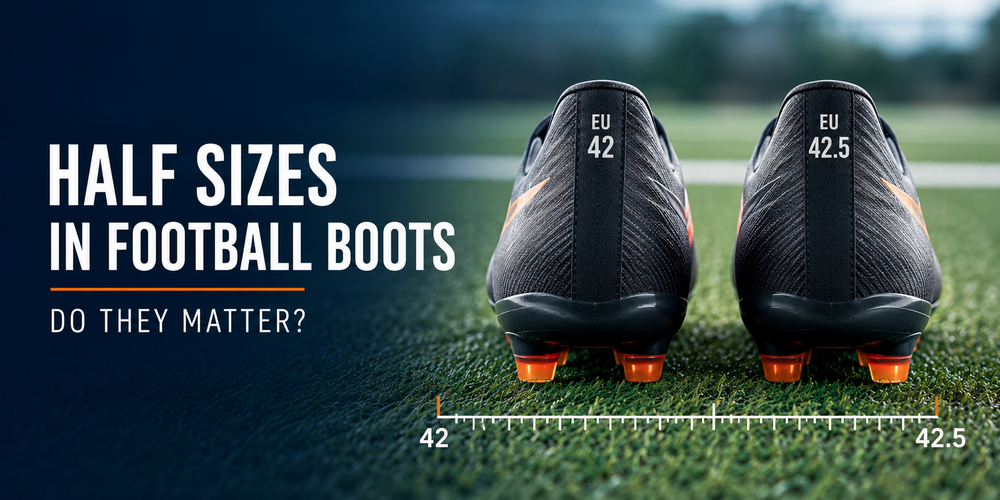
Half sizes in football boots can seem like a minor detail, but a few millimetres can change how securely the heel sits, how much space the toes have and how stable the foot feels during quick movements.
For professional and semi-professional players, a half size can make a noticeable difference because they often prefer a very precise fit. For children and teenagers, the priorities are different. Comfort, healthy toe space and a small amount of growth room are usually more important than an ultra-tight performance fit.
What Does a Half Size Change in Football Boots?
A half-size increase usually adds a small amount of internal length. Depending on the brand and model, it may also add slightly more width or volume.
The exact difference is not identical across every manufacturer. A half size can affect:
- toe space
- heel position
- midfoot lockdown
- forefoot pressure
- overall internal volume
- how the foot sits over the soleplate
Even a small change can be noticeable in a close-fitting football boot, especially during sprinting, stopping and rapid changes of direction.
Do Half Sizes Really Matter?
Yes, but they matter more in some situations than others.
A player who trains or plays several times per week may notice small differences in heel movement, toe pressure or lockdown. A casual player may care more about general comfort than a highly precise fit.
The effect also depends on the boot itself. A narrow, tapered speed boot may feel very different between two half sizes, while a softer or more accommodating boot may feel less sensitive to the same change.
Who Benefits Most From Half Sizes?
Professional and Semi-Professional Players
Professional and semi-professional players often benefit most from half-size precision because they usually want:
- minimal movement inside the boot
- secure heel lockdown
- consistent contact with the ball
- less sliding during explosive changes of direction
- a close fit without painful pressure
At a high level, small fit differences may become noticeable because the player spends many hours training and performing repeated high-speed movements.
Competitive Adult Players
Competitive amateur players can also benefit from half sizes, especially if they are between two full sizes or wear close-fitting synthetic boots.
However, the smaller size is not automatically better. A precise fit should still allow the toes to remain in a natural position without numbness or painful pressure.
Recreational Players
For recreational players, comfort is usually the main priority. A half size can still help, but there is no reason to choose an aggressively tight fit if a slightly roomier size feels more natural and secure.
Do Half Sizes Matter for Children and Teenagers?
They can matter, but the fitting priorities are different from those of adult professional players.
Children and teenagers should not wear boots that are excessively tight just to create a performance fit. Their feet may still be growing, and repeated pressure at the toes can quickly make the boots uncomfortable or unusable.
At the same time, buying boots far too large is not a good solution. Excess space can cause:
- heel slip
- blisters
- reduced control
- foot movement during turns
- difficulty striking the ball cleanly
A half size can sometimes provide the best balance between comfort, secure fit and a modest amount of growth room.
Younger Children
For younger children whose feet grow quickly, comfort and reasonable growth space are more important than an ultra-close fit.
Parents should check the fit regularly because a boot that was suitable at the start of the season may become too small several months later.
Older Teenagers
Older teenagers, especially academy or high-level players, may be more sensitive to half-size differences. If foot growth has slowed, their fitting priorities may be closer to those of adult players.
Even then, the boots should not cause numbness, curled toes or painful pressure.
How Much Difference Does Half a Size Make?
There is no universal measurement that applies to every brand. A half-size step is usually only a few millimetres, but the practical difference can feel larger because football boots are designed to fit closely.
The change can be more noticeable when:
- the toe box is strongly tapered
- the upper is thin and structured
- the heel is narrow
- the boot has limited stretch
- the player has one foot larger than the other
When Should You Choose the Smaller Half Size?
The smaller size may be the better option when:
- your toes sit close to the front without being compressed
- the heel is securely locked
- there is no numbness or tingling
- the forefoot feels snug but not painful
- the upper does not fold excessively
- you prefer a close performance fit
The boot should feel secure, but your toes should not curl or press painfully into the front.
When Should You Choose the Larger Half Size?
The larger half size may be more suitable when:
- your toes press into the front of the boot
- you feel pressure underneath the toenails
- your toes curl inside the boot
- you experience numbness
- your larger foot does not fit comfortably
- you use orthotics or thicker insoles
- you need modest growth space for a child or teenager
The larger size should still provide secure heel and midfoot lockdown. If the foot slides inside the boot, the larger size may be too long or the boot shape may not suit your foot.
Should You Size Up for Wide Feet?
Not automatically.
Sizing up can create more internal space, but it also adds length. This may cause:
- excess toe room
- heel movement
- reduced lockdown
- sliding during direction changes
- upper creasing
If the length is correct but the forefoot feels too tight, a wider boot model is usually a better solution than choosing extra length.
Read our football boot width guide or our guide to the best football boots for wide feet for more help.
Should You Size Down for a Tighter Fit?
Only when the smaller size remains comfortable.
Some players believe football boots should be painfully tight when new. That is not correct. A close fit can improve lockdown, but sizing down too far can cause:
- bruised toenails
- toe compression
- forefoot pain
- numbness
- reduced circulation
- difficulty wearing the boots for a full session
Snug is acceptable. Painful is not.
Do Leather Football Boots Justify Sizing Down?
Usually not.
Natural leather can soften and adapt slightly around the forefoot, but it does not become significantly longer. A leather boot that is painfully short will not become the correct length after breaking in.
If the boot is slightly firm around the width but the length is correct, the leather may adapt with use. If the toes are compressed, choose another size or model.
Do Synthetic Football Boots Stretch?
Most modern synthetic football boots stretch very little. They may soften slightly and become more flexible, but their basic shape and internal volume usually remain similar.
This makes correct initial sizing especially important for thin speed boots and other structured synthetic models.
For more information, read our guide on how to break in new football boots safely.
Why the Same Size Feels Different Across Brands
A labelled size does not guarantee an identical fit across every brand or model.
Differences can come from:
- toe-box shape
- last width
- heel construction
- upper thickness
- internal padding
- insole length
- overall boot volume
A UK 8.5 in one model may feel shorter, narrower or lower-volume than a UK 8.5 in another.
This is why the Football Boot Fitter considers foot width and playing surface rather than relying only on the size label.
How to Compare Two Half Sizes
When possible, try both sizes using the following method:
- Wear your normal football socks.
- Try both boots on both feet.
- Fit the larger foot first.
- Stand with your full weight on the feet.
- Check whether the toes remain in a natural position.
- Walk, jog and make controlled direction changes.
- Check for heel movement.
- Check whether the upper folds excessively.
- Keep the smaller size only if it remains comfortable.
- Keep the larger size only if it remains secure.
Half-Size Decision Guide
| Situation | Better starting point |
|---|---|
| Smaller size is snug but comfortable | Choose the smaller size |
| Toes press painfully into the front | Choose the larger half size |
| Length is correct but forefoot is too tight | Choose a wider model |
| Heel slips in the larger size | Try the smaller size or another shape |
| One foot is clearly larger | Fit the larger foot |
| Using orthotics | Test with the orthotics installed |
| Young player with fast-growing feet | Allow modest growth space |
| Adult competitive player | Prioritise precise lockdown and comfort |
Common Half-Size Mistakes
Choosing the Smaller Size Because Professionals Do
A professional-style fit is not suitable if it causes pain. The correct size should match your own foot shape, playing level and comfort requirements.
Buying One Full Size Larger for Growth
Buying boots far too large can reduce stability and cause blisters. A half size may sometimes offer a better compromise for growing players.
Using Extra Length to Solve a Width Problem
A longer boot is not necessarily a wider boot. If the forefoot is too tight, choose a model designed for wider feet.
Expecting the Boots to Stretch in Length
Football boots may soften in width or volume, but they do not normally become meaningfully longer.
Testing Only One Foot
Many people have one foot that is slightly longer or wider. Always fit the larger foot.
How Much Growth Room Should Children Have?
Children should have enough room for comfort and modest growth, but not so much that the foot moves inside the boot.
A practical fit should still provide:
- secure heel hold
- stable midfoot support
- natural toe position
- no painful pressure
- no excessive sliding
Because growth speed varies, parents should check the fit regularly instead of relying on a large amount of extra space at the time of purchase.
Does Playing Position Affect Half-Size Choice?
Playing position should not override proper fit.
Speed players may prefer a close, lightweight fit, while goalkeepers or defenders may prefer slightly more comfort. However, every player still needs secure lockdown and enough room for the toes to remain comfortable.
The correct size depends more on foot shape and boot construction than on position alone.
Bottom Line
Half sizes can make a meaningful difference in football boots, especially for professional, semi-professional and competitive adult players who want precise heel lockdown and minimal internal movement.
For children and teenagers, half sizes still matter, but comfort and modest growth room should take priority over an ultra-tight performance fit. Boots should not be painfully tight, but they should also not be bought excessively large.
Choose the smallest size that allows your toes to remain comfortable and natural while keeping the heel and midfoot securely locked. If the correct length feels too narrow, choose a wider boot model rather than simply adding more length.
Frequently Asked Questions
Do half sizes make a noticeable difference in football boots?
They can. A few millimetres may change toe space, heel lockdown and overall comfort, especially in close-fitting boots.
Should I size up or down in football boots?
Choose the smallest size that remains comfortable. Size up if the toes press painfully into the front, but do not choose extra length only to solve a width problem.
Should children wear football boots half a size bigger?
Sometimes. A half size can provide modest growth room, but the boot should still hold the heel securely and should not allow excessive foot movement.
Do professional players wear football boots too small?
Some professionals prefer a very close fit, but this does not mean recreational players should wear painfully small boots. Comfort and correct foot function remain important.
Can wide feet be solved by going half a size up?
Only if the smaller size is also too short. If the length is correct, choose a wider boot model instead.
Do leather football boots stretch enough to size down?
Leather may adapt slightly in width, but it does not become significantly longer. Do not buy a painfully short boot expecting it to stretch.
Do synthetic football boots stretch?
Most synthetic boots stretch very little. They may soften, but their basic shape and volume usually remain similar.
How should football boots fit at the toes?
The toes should sit close to the front without curling, numbness or painful pressure.
What if one foot is larger?
Fit the larger foot. A small insole or heel adjustment may help the smaller foot, but the larger foot should not be compressed.
Are half sizes important for teenagers?
They can be, especially for older or academy-level teenagers whose foot growth has slowed. Younger players should prioritise comfort and modest growth space.