

Not sure whether you have narrow, medium or wide feet, or which football boots are likely to fit you best?
You are not alone. Football boot sizing is often discussed only in terms of length, but two players wearing exactly the same shoe size can need very different boots because their forefoot width, foot volume, toe shape and heel shape are different.
This guide will help you work out whether your feet are narrow, medium or wide, show you how to measure them correctly, and explain what type of football boot fit to look for.
How Do I Know If I Have Narrow, Medium or Wide Feet?
The easiest starting point is to measure the width of your forefoot.
The important measurement is the area around the ball of your foot, usually the widest part of the forefoot.
Once you have that measurement, compare it with the reference values for your normal shoe size below.
Narrow feet. Your forefoot measurement is toward the lower end for your shoe size. Football boots with a tapered shape, close midfoot wrap and secure heel are more likely to work well.
Medium / standard feet. Your measurement falls around the average range. Most standard football boots should be a reasonable starting point, although model shape still matters.
Wide feet. Your forefoot measurement is toward the wider end for your shoe size. Look for boots with a broader forefoot, more internal volume and less aggressive taper.
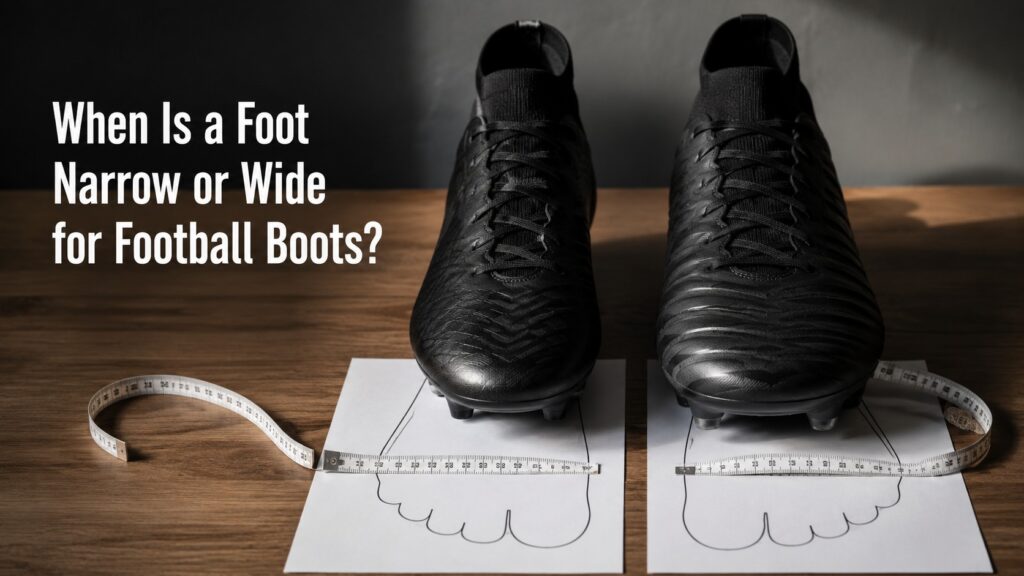
How to Measure Your Foot Width
- Place a sheet of paper on a hard floor.
- Stand on it with your full weight on the foot.
- Measure across the widest part of the forefoot, around the ball of the foot.
- Measure both feet.
- Use the measurement from the larger foot.
- Compare your result with the row closest to your normal shoe size in the tables below.
Measure your feet while standing rather than sitting, because the foot spreads slightly under body weight.
If possible, measure later in the day, when feet may be slightly larger than in the morning. Wear the type of socks you normally use with your football boots.
Football Boot Width Chart: Men’s Feet
Use the chart below as a practical reference for determining whether your foot is approximately narrow, medium/standard or wide for your shoe size.
Inches and centimeters
| UK size | Approx. EU size | Narrow | Medium / Standard | Wide |
|---|---|---|---|---|
| 5 | 38 | 3.2 in8.1 cm | 3.4 in8.6 cm | 3.6 in9.1 cm |
| 6 | 39 | 3.3 in8.4 cm | 3.5 in8.9 cm | 3.7 in9.4 cm |
| 7 | 40.5–41 | 3.4 in8.6 cm | 3.6 in9.1 cm | 3.8 in9.7 cm |
| 8 | 42 | 3.5 in8.9 cm | 3.8 in9.7 cm | 3.9 in9.9 cm |
| 9 | 43 | 3.6 in9.1 cm | 3.9 in9.9 cm | 4.1 in10.4 cm |
| 10 | 44–44.5 | 3.8 in9.7 cm | 4.0 in10.2 cm | 4.2 in10.7 cm |
| 11 | 45.5–46 | 3.9 in9.9 cm | 4.1 in10.4 cm | 4.3 in10.9 cm |
| 12 | 47 | 4.0 in10.2 cm | 4.3 in10.9 cm | 4.4 in11.2 cm |
Football Boot Width Chart: Women’s Feet
Inches and centimeters
| UK size | Approx. EU size | Narrow | Medium / Standard | Wide |
|---|---|---|---|---|
| 5 | 38 | 2.8 in7.1 cm | 3.2 in8.1 cm | 3.55 in9.0 cm |
| 6 | 39 | 2.95 in7.5 cm | 3.3 in8.4 cm | 3.7 in9.4 cm |
| 7 | 40.5–41 | 3.05 in7.7 cm | 3.45 in8.8 cm | 3.8 in9.7 cm |
| 8 | 42 | 3.2 in8.1 cm | 3.55 in9.0 cm | 3.95 in10.0 cm |
| 9 | 43 | 3.3 in8.4 cm | 3.7 in9.4 cm | 4.05 in10.3 cm |
| 10 | 44–44.5 | 3.45 in8.8 cm | 3.8 in9.7 cm | 4.2 in10.7 cm |
| 11 | 45.5–46 | 3.55 in9.0 cm | 3.95 in10.0 cm | 4.3 in10.9 cm |
| 12 | 47 | 3.7 in9.4 cm | 4.05 in10.3 cm | 4.45 in11.3 cm |
How to Read the Football Boot Width Chart
Find the row closest to your normal shoe size and compare your forefoot measurement with the narrow, medium/standard and wide values.
- Near the narrow value: you probably have a relatively narrow forefoot for your shoe size.
- Near the medium / standard value: your foot is likely around average width.
- Near or above the wide value: you likely need a football boot with more forefoot width or internal volume.
Example: A man wearing approximately UK 9 / EU 43 would be around the narrow range at 3.6 inches (9.1 cm), medium/standard around 3.9 inches (9.9 cm), and wide around 4.1 inches (10.4 cm).
What Width Football Boots Do I Need?
Knowing your foot width is only the first step.
Most football boots are not sold in formal narrow, medium and wide widths. Instead, every boot is built on a particular last — the three-dimensional shape around which the boot is constructed.
That is why two football boots in exactly the same size can feel completely different.
| Your foot type | What to look for in football boots |
|---|---|
| Narrow | Tapered forefoot, close midfoot wrap, secure heel and minimal excess material. |
| Medium / Standard | Snug but not compressed, even contact around the foot and secure lockdown without pressure points. |
| Wide | Broader forefoot, less aggressive taper, adequate midfoot volume and an upper that does not squeeze the ball of the foot. |
How Do I Know If I Need Wide Football Boots?
A width measurement is useful, but the way your current football boots feel also tells you a lot.
You may need a wider football boot if you regularly experience:
- Pressure around the ball of the foot
- Pressure on the little toe
- Numbness or tingling across the forefoot
- The upper visibly bulging over the edge of the soleplate
- Your foot feeling squeezed from both sides
- Boots that are comfortable in length but painfully tight in width
A football boot should feel snug and secure, but snug is not the same as painful.
How Do I Know If I Need Narrow Football Boots?
Players with narrow feet often have the opposite problem: the boot is long enough, but there is too much space around the foot.
Signs that a football boot may be too wide include:
- Your foot moves sideways inside the boot when changing direction
- You need to pull the laces extremely tight to get lockdown
- The upper folds or bunches excessively
- Your forefoot feels loose even though the length is correct
- Your heel or midfoot moves inside the boot
For narrow-footed players, a closer-fitting football boot can improve lockdown without forcing you to size down unnecessarily.
A Tight Football Boot Does Not Automatically Mean You Have Wide Feet
This is important.
If a football boot feels tight, that does not automatically mean your feet are wide.
The problem could instead be:
- A narrow or tapered toe box
- A low-volume midfoot
- A pointed boot shape that does not match your toes
- An upper with very little give
- The wrong boot size
- The particular last used by that model
This is why foot width should always be considered together with foot volume and toe shape.
Foot Width vs Foot Volume: What’s the Difference?
Foot width and foot volume are related, but they are not the same thing.
Foot width is the horizontal measurement across the forefoot.
Foot volume describes how much three-dimensional space your foot occupies inside the boot — including the height of your instep and the overall depth of your foot.
For example, two players may both measure 10 cm across the forefoot, but one may have a low instep while the other has a much higher-volume foot.
Those two players may prefer completely different football boots even though their measured width is similar.
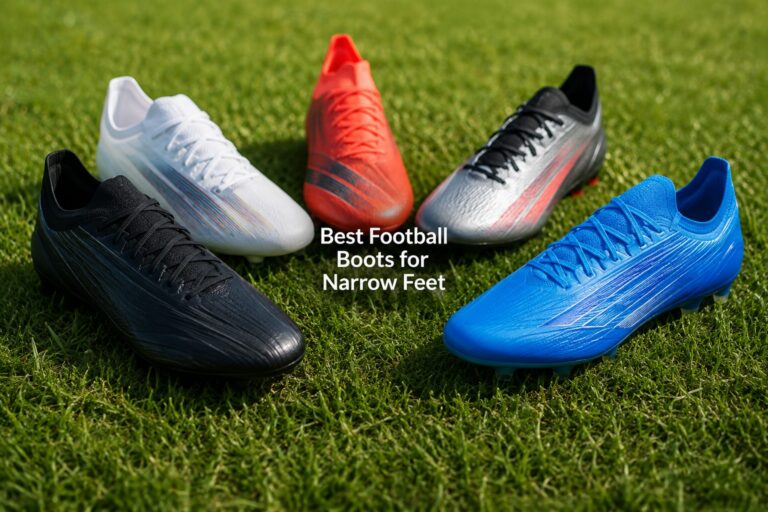
Football Boots for Narrow Feet
Narrow-footed players usually benefit from football boots with:
- A tapered forefoot
- Strong midfoot lockdown
- A close-fitting heel
- Less excess upper material
- A relatively low-volume fit
Speed boots such as the Nike Mercurial and Adidas F50 are often associated with a closer, more tapered fit, although the exact fit changes between generations, materials and price tiers.
For specific recommendations, see our Best Football Boots for Narrow Feet guide.
Football Boots for Medium / Standard Feet
If your foot falls around the medium or standard range, you have the widest choice of football boots.
Most mainstream football boots are designed around an approximately standard-width foot, but that does not mean every model will fit you equally well.
Toe shape, instep height, heel width and upper construction can still make one model much more comfortable than another.
A good medium-width football boot should feel:
- Close around the foot
- Secure during acceleration and changes of direction
- Free from painful pressure points
- Stable without excessive lace tension
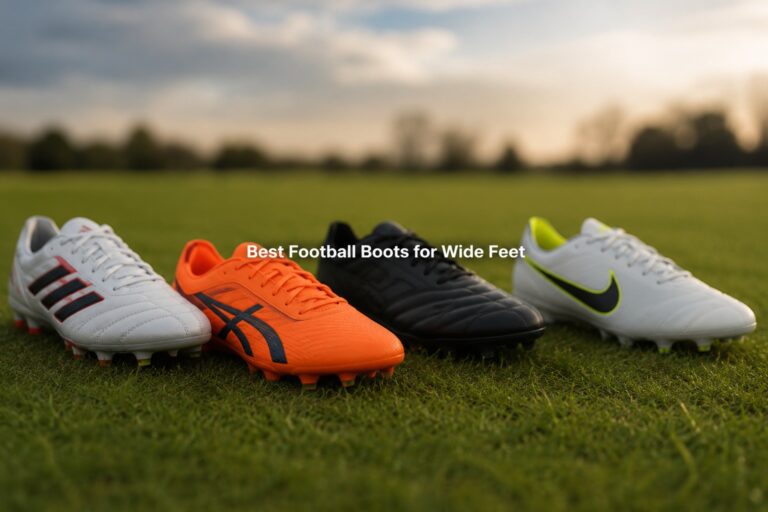
Football Boots for Wide Feet
Wide-footed players generally need football boots with:
- A broader forefoot
- A rounder or less tapered toe box
- More space over the midfoot
- An adaptable upper
- A soleplate that does not feel excessively narrow under the foot
Models such as the Mizuno Morelia II, Mizuno Monarcida, New Balance 442 and Joma Top Flex can be useful starting points for wider feet.
Some comfort-oriented Puma King models and other traditional football boots may also work, depending on the exact generation and fit.
See our full Best Football Boots for Wide Feet guide for model-by-model recommendations.
Why Football Boot Width Labels Are Not Enough
Football boots are different from many running shoes because most models are not sold with formal width labels such as Narrow, D, 2E or 4E.
Instead, the fit depends on the shape of the entire boot.
Important factors include:
- Forefoot width
- Toe-box shape
- Midfoot volume
- Heel width
- Upper material
- Soleplate width
- How aggressively the boot tapers toward the toes
Two boots that would both be described as “standard width” can therefore fit very differently.
This is also why the Football Boot Finder uses width as one part of the recommendation rather than treating it as the only factor.
Should Football Boots Feel Tight?
Football boots should fit closer than ordinary trainers, but they should not cause pain.
A good fit should feel snug, secure and responsive. Your foot should not slide around inside the boot when accelerating, stopping or changing direction.
But the boot should also not cause:
- Sharp pressure
- Numbness
- Persistent tingling
- Crushing around the little toe
- Your toes being forced together
If you experience those symptoms, the boot may simply be the wrong shape or width for your foot.
Do Football Boots Stretch?
Some natural-leather football boots soften and adapt slightly to the foot with use.
Most modern synthetic football boots stretch much less, although the upper may become more flexible after several training sessions.
Do not buy a football boot that is painfully narrow because you expect it to stretch dramatically.
A new boot can feel close, but it should not cause significant pain or numbness from the start.
Should I Size Up If My Football Boots Are Too Narrow?
Usually, no.
Going up a full size simply to gain width can create too much space in front of the toes and may lead to heel slip or unwanted movement inside the boot.
It is generally better to choose a wider football boot in the correct length than a longer football boot that still has the wrong shape.
Common Foot-Width Measuring Mistakes
Measuring while sitting
Your foot spreads more when you stand. Measure with your full body weight on the foot.
Measuring only one foot
Many people have one foot that is slightly larger or wider than the other. Measure both and use the larger measurement.
Measuring the wrong part of the foot
Measure across the widest part of the forefoot around the ball of the foot — not across the arch or heel.
Assuming width is the only fit measurement
A width measurement cannot tell you everything about how a football boot will fit. Instep height, toe shape and heel shape also matter.
Sizing up just to gain width
A longer boot can create excessive toe space and heel movement. Choosing a better-shaped boot is normally the better solution.
Use Your Foot Width to Find the Right Football Boots
Once you know whether your feet are approximately narrow, medium or wide, you can dramatically reduce the number of football boots you need to consider.
But width is only part of the equation.
The ideal football boot should match:
- Your foot width
- Your foot volume
- Your toe shape
- Your size
- Your playing surface
Use our Football Boot Finder to combine your foot width with your size and playing surface and narrow down football boots that are more likely to fit.
Frequently Asked Questions
How do I know if I have wide feet?
Measure across the widest part of your forefoot while standing and compare the result with the reference value for your shoe size. If your measurement is near or above the wide range, you probably have a relatively wide forefoot.
How do I know if I have narrow feet?
If your forefoot measurement is close to the narrow reference for your shoe size and standard football boots often feel loose around the forefoot or midfoot, you probably have relatively narrow feet.
What is a medium or standard-width foot?
A medium or standard-width foot falls approximately around the average width for that shoe size. Most football boots are designed around an approximately standard fit, although individual boot lasts still vary substantially.
How do I know whether I need narrow, medium or wide football boots?
Start by measuring your forefoot width. Then consider how football boots normally fit you. Excessive side-to-side movement can indicate that a boot is too wide, while pressure around the ball of the foot or little toe can indicate that it is too narrow.
Should I size up if my football boots feel too narrow?
Usually not. Going up in size can create excess length and heel movement. Choosing a wider football boot in the correct length is generally a better solution.
Do leather football boots stretch more than synthetic boots?
Natural leather can soften and adapt somewhat to the shape of the foot. Most synthetic football boots stretch much less, so the initial fit needs to be reasonably close to correct.
Can wide feet wear Nike Mercurial or Adidas F50 football boots?
Some players can, but these speed-boot families generally have a more tapered fit than many traditional leather-style boots. Players with wide feet should evaluate them carefully rather than assuming the upper will stretch enough.
Are men’s and women’s football boot widths the same?
Not necessarily. Women’s-specific football boots may use a different last, heel shape or internal volume. A size label alone does not guarantee an identical fit.
Is foot width the same as foot volume?
No. Width is the horizontal measurement across the forefoot. Foot volume includes the overall three-dimensional space your foot requires inside the boot, including instep height.
Are football boots and soccer cleats the same thing?
In most contexts, yes. “Football boots” is the common term in the UK and much of Europe, while “soccer cleats” is commonly used in the United States. “Football shoes” is also used in some regions. The fit principles in this guide apply regardless of the terminology.
Bottom Line
If you want to know whether you have narrow, medium or wide feet, start by measuring the widest part of your forefoot while standing.
Compare that measurement with your shoe size, then use it as a starting point when choosing football boots.
But remember: foot width alone does not determine football boot fit. Toe-box shape, foot volume, heel shape, upper material and the last used by each boot can be just as important.
Once you know your approximate foot width, use the Football Boot Finder to narrow down models suited to your feet and playing surface.