

If football boots regularly feel tight across the forefoot, press against your little toe or force you to buy a longer size, the problem may be the shape of the boot rather than its stated size.
The best football boots for wide feet provide additional room through the forefoot and toe box while still holding the heel and midfoot securely. A football boot should feel close and responsive, but it should not crush the toes, cause numbness or create painful pressure along the outside of the foot.
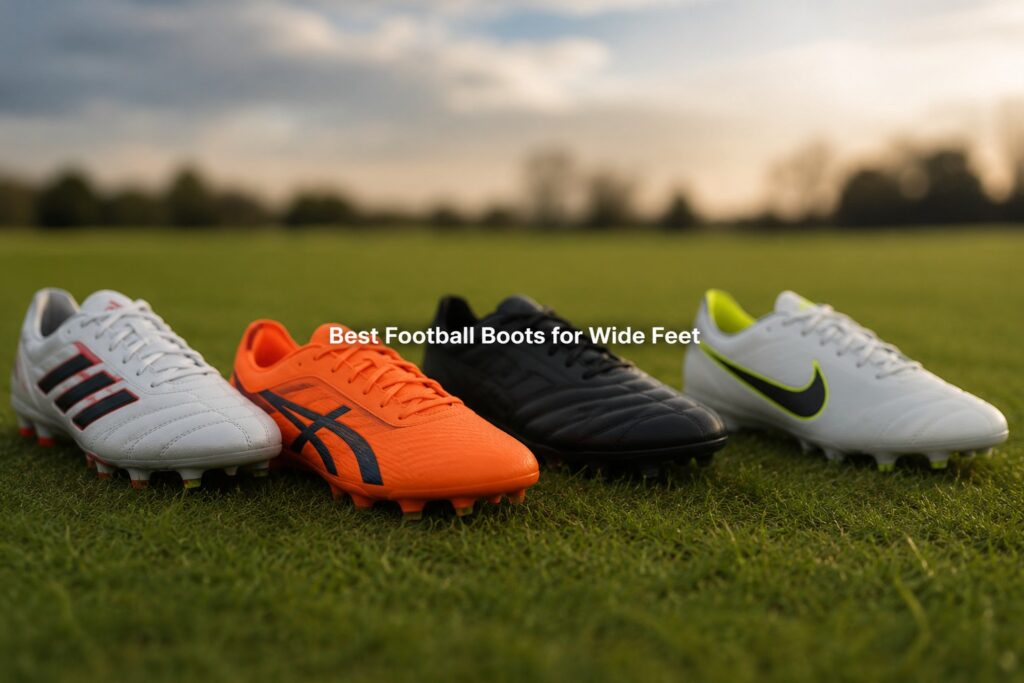
Best Football Boots for Wide Feet
The following models are among the more accommodating options currently available. Width can still vary between generations, materials, price tiers and soleplates, so use these recommendations as a starting point rather than a guarantee.
| Boot | Likely fit | Best for |
|---|---|---|
| Mizuno Morelia II | Medium-wide to wide | Premium comfort and an adaptable traditional upper |
| New Balance 442 | Medium-wide to wide | Players wanting a classic shape and wider fit options |
| Mizuno Monarcida | Medium-wide to wide | Comfort, value and regular club use |
| Joma Top Flex | Wide and higher-volume feet | Flexible comfort and value |
| Umbro Speciali / Tocco | Medium-wide | Traditional construction and a less tapered shape |
| Puma King | Medium to medium-wide | Players needing moderate room rather than a truly wide last |
| Kipsta Viralto | Medium-wide | Children, amateurs and budget-conscious players |
How to Know if You Have Wide Feet
You may need a wider football boot when:
- The length is correct but the forefoot feels compressed.
- Your little toe presses painfully against the side of the upper.
- You regularly size up only to obtain more width.
- Your feet become numb or burn during play.
- Your foot visibly spreads beyond the edge of the soleplate.
- The upper bulges heavily around the forefoot.
- Narrow speed boots feel restrictive even when the length is correct.
Foot width is independent of shoe size. A player wearing EU 40 can have wide feet, while someone wearing EU 45 can have relatively narrow feet.
Your foot may also be wide in only one area. Some players have a broad forefoot with a narrow heel, while others have greater volume through the midfoot and instep.
For a more detailed check, read our Football Boot Width Chart.
How We Assess Football-Boot Width
Football-boot fit cannot be judged by brand name alone. Nike, Adidas, Puma and Mizuno all produce boots with different shapes within their ranges.
We assess the overall shape and construction of each boot, including:
- Forefoot width and toe-box shape
- Space around the little toe
- Midfoot width and internal volume
- Lacing adjustability
- Upper softness and adaptability
- Heel shape and lockdown
- Differences between generations and price tiers
A boot can have a wide forefoot but still feel restrictive through the midfoot. Another may feel soft and comfortable when standing but allow too much movement when sprinting.
The aim is not simply to find the widest boot. It is to find a shape that provides enough forefoot room while keeping the heel and midfoot secure.
Mizuno Morelia II
The Mizuno Morelia II is one of the safest premium starting points for players with medium-wide or wide feet.
Its traditional construction and adaptable upper provide more natural forefoot space than the narrower, more tapered Morelia Neo line. The lacing system also allows the upper to open more effectively around the midfoot.
The Morelia II should still fit securely. It is not an oversized or shapeless boot, but it is less restrictive than most modern speed boots.
Best for:
- Medium-wide to wide feet
- Players with a broad forefoot
- Those who prefer a traditional, close-to-foot feel
- Buyers prioritising comfort and adaptability
Consider another model if: you have an extremely high-volume foot or specifically need a factory-produced extra-wide fitting.
New Balance 442
The New Balance 442 combines a traditional shape with a more accommodating forefoot than many streamlined speed boots.
One important advantage is that New Balance offers selected football boots in dedicated wider fittings in some markets. This can be more reliable than simply sizing up a standard-width boot.
The exact availability of wide versions depends on the model, generation, soleplate and country, so check the product listing carefully.
Best for:
- Medium-wide and wide feet
- Players wanting a classic boot shape
- Those who need stronger heel lockdown than very soft boots provide
- Buyers who can access the dedicated wide version
Check before buying: Standard and wide-width versions are not the same. Make sure the product is explicitly marked as wide when that is what you need.
Mizuno Monarcida
The Mizuno Monarcida is a practical option for players who want some of the comfort and fit philosophy associated with Mizuno without paying Morelia prices.
Selected Monarcida versions are officially described as wide fitting. The softer upper and less restrictive shape can make them particularly useful for club players, younger players and regular training.
The range contains several different versions, however, and they should not all be assumed to fit identically.
Best for:
- Medium-wide to wide feet
- Club players and regular training
- Parents seeking a practical children’s boot
- Buyers prioritising value and comfort
Check before buying: Look at the exact Monarcida model because width specifications may vary by market and version.
Joma Top Flex
The Joma Top Flex is known for its flexible, comfort-oriented construction and generally accommodating shape.
It is particularly relevant for players with a wider forefoot or greater overall foot volume. The flexible upper can adapt more effectively than the thin synthetic materials used in many speed boots.
Top Flex models are especially common for turf, indoor and futsal use, although the exact versions and soleplates available depend on the market.
Best for:
- Wide or higher-volume feet
- Players prioritising comfort
- Futsal, turf and hard-ground use
- Value-conscious buyers
Consider another model if: you want the lightest possible speed-boot feel or a highly rigid outsole.
Umbro Speciali and Tocco
Selected Umbro Speciali and Tocco models use a more traditional, less tapered shape than many current speed boots.
The Speciali is generally the more obvious starting point for wider-footed players, although fit can vary considerably between older and newer generations. Some Tocco models may also provide a reasonable medium-wide fit.
Best for:
- Medium-wide feet
- Players who prefer a softer upper
- Traditional-boot buyers
- Those who find modern speed boots too tapered
Check before buying: Umbro availability varies by country, and older versions may fit differently from current ones.
Puma King
The Puma King is generally more accommodating than Puma’s narrowest speed-oriented models, but it should not automatically be described as a truly wide boot.
Current synthetic King models do not necessarily stretch or adapt in the same way as older leather versions. For that reason, the King is better classified as a possible option for medium to moderately wide feet.
Best for:
- Medium to medium-wide feet
- Players wanting more room than a typical speed boot
- Those who still want a relatively streamlined fit
Consider another model if: you have a very broad forefoot, high instep or require substantial additional volume.
Kipsta Viralto
The Kipsta Viralto range can offer a comfortable and reasonably accommodating fit at a lower price.
It is particularly relevant for children, amateur players and buyers who do not need an expensive Elite-level boot. Some Viralto versions provide more forefoot room than the narrowest mainstream speed boots.
Fit may vary between entry-level and higher-tier versions, so the exact boot still needs to be checked.
Best for:
- Medium-wide feet
- Children and recreational players
- Training and amateur matches
- Budget-conscious buyers
What about other famous football boots?
Are Nike Mercurials Good for Wide Feet?
Nike Mercurials are generally not the best starting point for genuinely wide feet.
Nike classifies the Mercurial as a contoured-fit football boot. This means it is designed to fit closely around the foot with less internal space than Nike’s more natural-fitting Tiempo and Phantom ranges.
The Mercurial commonly feels close through the midfoot and forefoot. Its streamlined construction can create pressure around the little toe or outside edge of a broad foot.
Players with only slightly wide feet may still fit some Mercurial generations or lower price tiers. However, sizing up does not change the underlying shape and can leave unnecessary space in front of the toes.
Mercurials may work for:
- Narrow feet
- Medium-width feet
- Slightly wide feet when the exact version fits comfortably
- Players who deliberately prefer a very close fit
Mercurials are less suitable for:
- Genuinely wide forefeet
- High-volume feet
- Players who already experience little-toe pressure
- Anyone relying on a larger size purely to gain width
Are Adidas F50 Boots Good for Wide Feet?
Adidas F50 boots are also not among the safest choices for genuinely wide feet.
The F50 is designed as a lightweight speed boot with a thin upper and secure internal lockdown. The Elite version uses a compression-style tongue intended to hold the foot closely during acceleration.
Adidas officially describes the standard F50 as regular fitting, but a regular label does not mean that it is ideal for a broad or high-volume foot. The streamlined upper and close midfoot wrap can still feel restrictive, particularly for players who need substantial forefoot width.
Some players with medium or slightly wide feet may fit the F50, depending on the generation, upper and price tier. The Messi versions and standard versions can also feel different because of their tongue constructions.
Adidas F50 may work for:
- Narrow to medium-width feet
- Slightly wide feet with lower foot volume
- Players who prefer a close speed-boot fit
Adidas F50 is less suitable for:
- Genuinely wide feet
- Broad forefeet combined with a high instep
- Players who need significant toe-box space
- Anyone who already finds Adidas speed boots restrictive
Other Boots to Approach Carefully
The following models are not poor football boots, but their shapes are less reliable for genuinely wide feet:
- Skechers Razor: Generally better suited to narrow-to-medium feet than broad or high-volume feet.
- Lotto Solista: Uses a tapered speed-oriented shape rather than a wide-foot design.
- Mizuno Morelia Neo: More tapered and streamlined than the Morelia II.
- Puma Ultra: A close-fitting speed boot that may restrict wider forefeet.
- Under Armour Shadow: Usually better suited to narrow or lower-volume feet.
Some players with slightly wide feet may still fit these boots. Fit should always be judged using the exact generation, tier and soleplate rather than a general model name alone.
Are Nike Tiempo and Phantom Better for Wide Feet?
Nike identifies the Tiempo and Phantom as its more natural-fitting football-boot ranges. They therefore make more sense for wider feet than the Mercurial.
That does not mean every Tiempo or Phantom is truly wide. They are better described as more accommodating Nike options.
The Phantom is often useful for medium to moderately wide feet because of its more rounded forefoot shape. The Tiempo can also work for medium and slightly wide feet, although recent synthetic versions may not adapt as much as older leather models.
Within the Nike range:
- Mercurial: Close, contoured fit
- Tiempo: More natural and accommodating fit
- Phantom: More natural fit with additional forefoot room
Players with genuinely wide feet should still compare Nike models with dedicated wider options from New Balance or accommodating models from Mizuno and Joma.
Should You Size Up for Wide Feet?
Only consider sizing up when the boot is slightly tight and the additional length remains acceptable.
A larger size does not change the basic shape of a narrow football boot. It may leave excess space in front of the toes while the midfoot or forefoot continues to feel restrictive.
A better buying order is:
- Choose a model with a more suitable shape.
- Try your normal measured size.
- Check forefoot pressure and heel lockdown.
- Only then compare half a size up when necessary.
How Wide Football Boots Should Feel
A correctly fitted wide football boot should provide:
- No sharp or painful pressure along the outside of the forefoot
- Enough space for the toes to sit naturally
- No numbness, burning or tingling
- Secure heel lockdown
- No excessive sideways movement
- A close midfoot wrap without pinching
Some initial snugness is normal, especially in a performance boot. Pain, numbness and obvious soleplate overhang are not signs of a proper performance fit.
More width should not mean that the foot moves freely inside the boot. The objective is targeted room in the forefoot combined with secure support elsewhere.
Wide Forefoot but Narrow Heel
Many players have a wide forefoot but a relatively narrow heel. Buying the widest possible boot can solve the forefoot problem while creating heel movement.
In this situation, look for:
- An accommodating forefoot
- A deep, shaped heel cup
- Traditional central lacing
- A tongue that allows the midfoot fit to be adjusted
- Secure lockdown without excessive compression
The Mizuno Morelia II and New Balance 442 are useful starting points because they combine forefoot space with a more structured heel than some very soft comfort boots.
Wide Feet and High Instep
Width and volume are not the same.
A player can have a moderately wide foot but a high instep that makes boots feel extremely tight across the top. One-piece uppers and fixed compression tongues can be especially restrictive in this area.
Players with a high instep should usually prioritise:
- Traditional separate tongues
- Longer lacing systems
- Adjustable upper openings
- Softer materials over the midfoot
This is another reason why a traditionally constructed boot may fit better than a close-fitting speed model.
Choose the Correct Soleplate
Width alone is not enough. The outsole must also match the surface on which you play.
- AG: Designed for regular use on artificial grass.
- FG: Intended mainly for firm natural grass.
- MG: A compromise for players alternating between suitable firm-ground and artificial surfaces.
- TF: Designed for short artificial turf and harder synthetic pitches.
- SG: Intended for soft, wet natural grass.
Do not choose an unsuitable soleplate simply because the wider model is easier to find. Surface suitability affects traction, comfort, durability and injury risk.
Wide Football Boots for Children
Children with wide feet are usually better served by a comfortable Academy, Pro or equivalent mid-tier boot than by an expensive Elite boot that is too narrow.
Growing room should remain modest. Oversized boots can reduce stability, lockdown and control while allowing the foot to slide.
Parents should check:
- Pressure around the little toe
- Whether the child’s foot spreads beyond the soleplate
- Heel movement while walking and running
- Whether the toes can lie naturally
- Whether the child reports numbness after training
The Mizuno Monarcida, New Balance 442 and selected Kipsta Viralto models are sensible starting points for wider children’s feet.
What About Women-Specific Football Boots?
Women-specific boots are not automatically narrow, nor are unisex boots automatically too wide.
A women-specific last may differ in heel shape, volume, arch position or overall proportions. The correct choice still depends on the individual foot.
A unisex model can be the better option when its length, width and heel shape match correctly. Likewise, a women-specific boot may provide improved lockdown for some players.
Fit should be based on foot shape rather than the gender label alone.
Use the Football Boot Finder
The Football Boot Finder ranks boots according to foot width, playing surface and playing level.
Select Wide to prioritise the more accommodating models before comparing available tiers and soleplates.
Final Recommendation
For genuinely wide feet, begin with the Mizuno Morelia II, New Balance 442, Mizuno Monarcida or Joma Top Flex.
The New Balance 442 is particularly useful when a dedicated wide fitting is available. The Morelia II provides a premium, adaptable traditional fit, while the Monarcida offers a more affordable wide-foot option. The Joma Top Flex is worth considering for broad or higher-volume feet, particularly for turf and futsal use.
Umbro Speciali, Puma King and Kipsta Viralto models may also work, but their suitability depends more heavily on the exact generation and tier.
Nike Mercurial and Adidas F50 boots should be approached more carefully. Both are speed-oriented ranges with closer-fitting constructions and are generally better suited to narrow, medium or only slightly wide feet.