

Running shoe drop is one of those terms that appears in many shoe reviews, but it is not always explained clearly. Drop can affect how a shoe feels, but it should not be chosen in isolation.
The best drop depends on your running style, comfort, injury history, calf tolerance and what shoes you are already used to.
What Is Heel-to-Toe Drop?
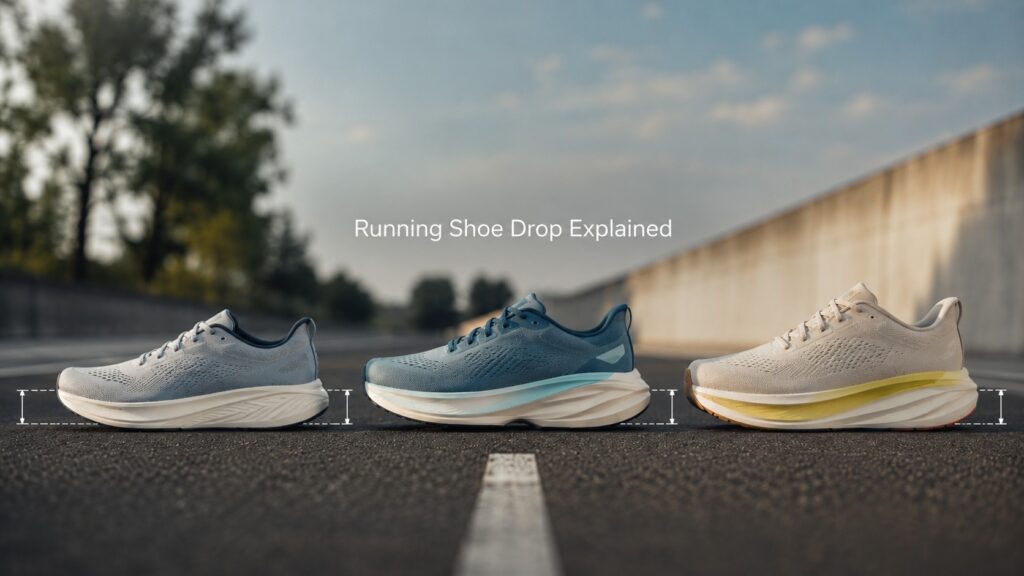
Heel-to-toe drop is the difference in stack height between the heel and the forefoot.
For example, if a shoe has 34 mm under the heel and 24 mm under the forefoot, the drop is 10 mm.
High Drop Running Shoes
High drop shoes usually have around 8 to 12 mm of drop. They place the heel noticeably higher than the forefoot.
High drop shoes may suit:
- heel strikers
- runners used to traditional running shoes
- runners who prefer less calf and Achilles load
- people who want a familiar daily trainer feel
High drop does not mean bad. Many excellent daily trainers use a higher drop.
Medium Drop Running Shoes
Medium drop shoes often sit around 5 to 8 mm. They can feel balanced for many runners.
This range is common in modern daily trainers because it does not feel too extreme in either direction.
Low Drop Running Shoes
Low drop shoes usually sit around 0 to 4 mm. They put the heel and forefoot closer to the same height.
Low drop shoes may suit:
- runners who prefer a more natural ground feel
- midfoot or forefoot strikers
- runners already adapted to lower-drop shoes
- trail runners who like stable ground contact
Low drop can increase demand on the calves and Achilles. Transition slowly if you are used to higher-drop shoes.
Does Drop Change Your Running Form?
It can influence how the shoe feels and where load is placed, but it does not magically fix running form.
A lower drop does not automatically make you run better. A higher drop does not automatically make a shoe safer.
How to Choose Running Shoe Drop
Stay close to what works
If you are running comfortably in 8 to 10 mm drop shoes, there is no urgent reason to change.
Change gradually
If you want to try lower drop, do it slowly. Use the new shoes for short runs first.
Consider your calves and Achilles
If you often have calf or Achilles tightness, be careful with sudden low-drop changes.
Think about the whole shoe
Drop is only one part of the design. Cushioning, rocker shape, stiffness, width and stability also matter.
Common Mistakes
Choosing low drop because it sounds more natural
Natural does not automatically mean better for your body or training.
Ignoring transition time
A big drop change can feel fine at first but overload tissues over several runs.
Comparing drop without stack height
A 4 mm drop shoe with a very high stack can feel very different from a 4 mm minimalist shoe.
Bottom Line
Running shoe drop affects feel and load distribution, but it should not be your only buying factor.
Choose a drop that feels comfortable, matches your running history and supports your normal training. Change gradually if you move to a very different drop.
Use the Running Shoe Fitter to narrow down shoes by cushioning, foot type, running style and training use.