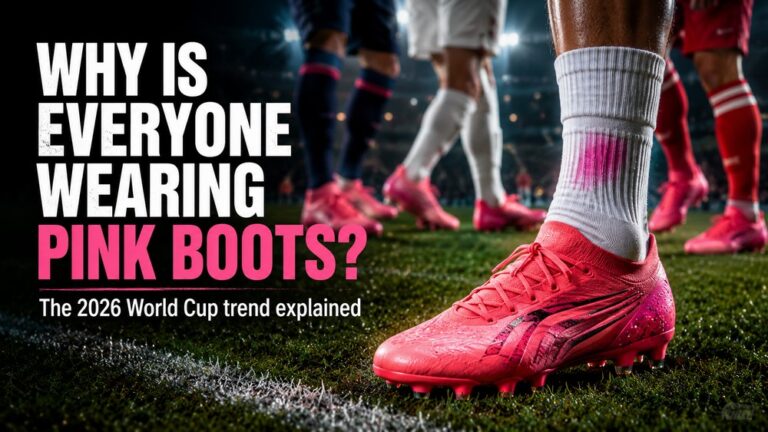


Look closely at the players’ feet during the 2026 World Cup and one thing quickly becomes obvious.
Pink football boots are everywhere.
But beneath all those similar colours, the biggest boot brands are fighting a much closer battle than it first appears. Nike and Adidas are separated by only a few percentage points, while two famous speed boots are pulling away from everything else.
So which football boot is actually being worn by the most players at the 2026 World Cup?
The answer is close, but there is a winner.
Nike and Adidas Are Almost Level
According to boot-count data collected during the opening stage of the tournament, Nike currently has the largest overall share.
- Nike: 42.6% of players
- adidas: 40.3%
- PUMA: 10.2%
- Mizuno: 2.4%
- Skechers: 1.7%
- New Balance: 1.2%
That gives Nike the lead, but not by much. More than eight out of every ten players are wearing either Nike or Adidas boots.
PUMA remains the clear third brand, while Mizuno, Skechers and New Balance account for a much smaller group of players.
But Which Individual Boot Is Number One?
This is where the battle becomes more interesting.
Nike may lead the overall brand ranking, but most of its players are concentrated in one boot family. Around 61% of Nike-sponsored players are wearing the Nike Mercurial.
At adidas, approximately 54.2% are using the Adidas F50.
When those figures are combined with each brand’s overall tournament share, the estimated ranking looks like this:
- Nike Mercurial — approximately 26% of all players
- adidas F50 — approximately 22%
- adidas Predator — approximately 13%
- Nike Phantom — approximately 11%
- PUMA Future — approximately 6%
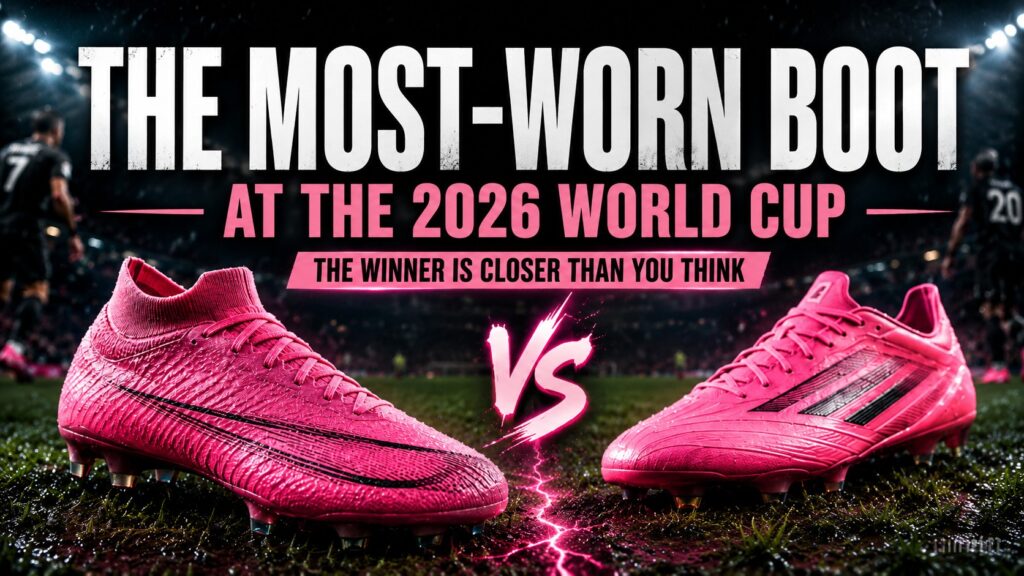
That makes the Nike Mercurial the most-worn football boot at the 2026 World Cup so far.
However, the Adidas F50 is close enough that the ranking could still shift as the tournament continues.
Why Are Speed Boots Dominating?
The Mercurial and F50 are both marketed as lightweight speed boots.
Together, they are worn by almost half of all players at the tournament.
That does not mean every player wearing them is a winger or striker. Modern speed boots are now used in almost every position, including by full-backs, midfielders and even central defenders.
Professional players often prefer them because they offer:
- A close, streamlined fit
- A thin upper with a direct touch on the ball
- Low overall weight
- A responsive soleplate
- A secure feeling when sprinting and changing direction
There is also the influence of sponsorship. Major brands place their newest speed boots on many of the tournament’s most visible players, helping the models stand out during matches, highlights and social-media clips.
The Mercurial Has the Biggest Nike Roster
The Mercurial has been one of football’s most recognizable boot families since the late 1990s.
At the 2026 World Cup, it is once again Nike’s dominant model. Around 61% of Nike athletes are wearing either the low-cut Mercurial Vapor or the collared Mercurial Superfly.
The Nike Phantom accounts for around 24.8% of the company’s players, while the Tiempo sits much further behind at approximately 12.2%.
This confirms how heavily Nike’s World Cup presence now depends on the Mercurial line.
The Adidas F50 Is Not Far Behind
Adidas brought the F50 name back as its main lightweight speed option, and the return has clearly worked.
Approximately 54.2% of Adidas players are wearing the F50 at the tournament. The Predator follows at around 32.8%, while the Copa accounts for approximately 11%.
The F50 is also supported by some of the most recognizable players in world football, giving it enormous visibility throughout the competition.
On the pitch, the fight between Mercurial and F50 is much tighter than the overall brand figures initially suggest.
Where Does PUMA Fit In?
PUMA holds just over 10% of the tournament’s overall boot share.
Within its own group of players, the Future is the most popular model at approximately 56.6%. The lighter PUMA Ultra accounts for around 33.4%, while the King represents the remaining 10%.
The Future therefore ranks fifth overall, but it remains a long way behind the Mercurial and F50.
Does the Most Popular Boot Mean It Is the Best?
No.
Professional boot counts are heavily influenced by sponsorship agreements. A player may also receive customized boots that differ from the version sold in shops.
The most frequently worn model is therefore not automatically the best option for every amateur player.
The Nike Mercurial generally has a close, narrow-to-medium fit. Players with wider feet may find another model more comfortable, even if the Mercurial is the tournament’s most popular boot.
Before choosing a model, read our guide on how to choose the right football boots.
You can also use our football boot width chart to check whether your feet are narrow, standard or wide.
The correct boot is the one that fits your foot, your playing surface and your budget, not necessarily the one worn by the most professionals.
The World Cup Boot Battle Is Not Over
For now, the Nike Mercurial holds the title of the most-worn football boot at the 2026 World Cup.
The Adidas F50 is close behind, while the Predator, Phantom and PUMA Future complete the leading group.
But with much of the tournament still to come, the final ranking could change. Players may switch boots, different teams will progress, and the models worn in the biggest knockout matches will receive the most attention.
At this stage, though, one thing is clear: the World Cup’s biggest equipment battle is not simply Nike against adidas.
It is Mercurial against F50, and the Mercurial currently has the edge.