

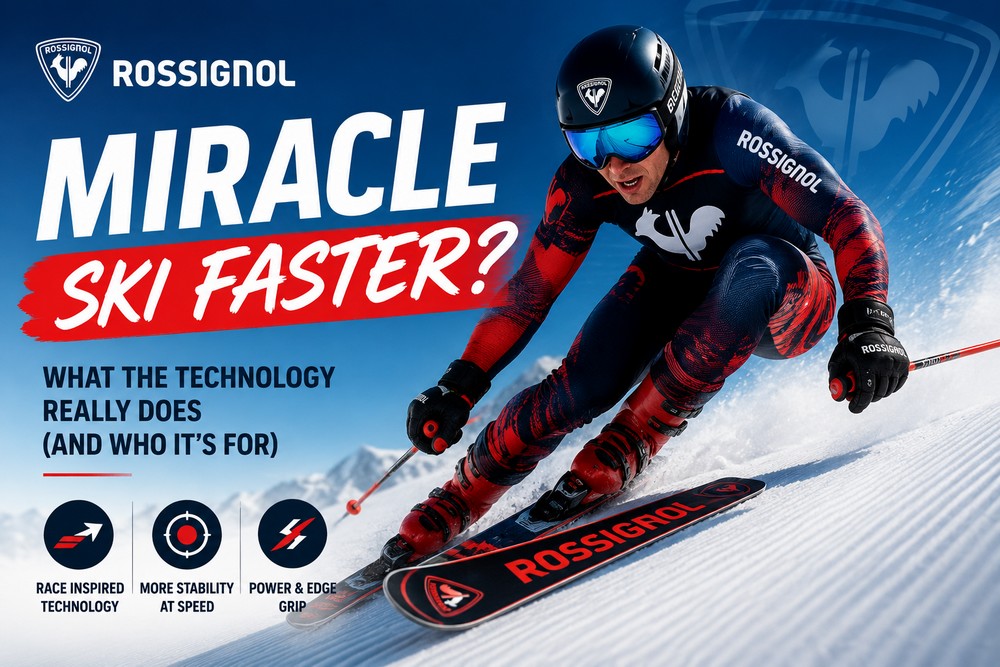
Was one ski really faster than everything else on the mountain?
That was the question being asked across alpine skiing after Rossignol racers suddenly began appearing near the top of major downhill results.
The rumours became especially loud after Giovanni Franzoni won the legendary Kitzbühel downhill on the Streif. Some began calling his Rossignol setup a “miracle ski”, a ski that supposedly carried more speed than its rivals.
But was Rossignol really hiding a major technical advantage, or was this simply the perfect combination of athlete, ski and conditions?
How the “Miracle Ski” Rumour Started
The discussion gathered momentum during the 2025/26 World Cup season.
Franzoni produced a major breakthrough, winning both at Wengen and on the famous Streif in Kitzbühel. His Kitzbühel victory was particularly significant because the course rewards courage, precision and exceptional gliding speed.
Rossignol also placed several racers high in the results, leading some observers to wonder whether the brand had developed an unusually fast downhill ski.
In ski racing, even a very small advantage can matter. A few hundredths of a second gained through better glide, pressure distribution or ski preparation can decide a race.
What Could Make One Race Ski Faster?
There is rarely one single secret.
The final speed of a downhill ski can depend on:
- The construction and flex of the ski
- How pressure is distributed along the base
- The base material and structure
- Grinding and preparation
- Wax selection
- Snow temperature and humidity
- The skier’s position and technique
A ski that is extremely fast in one type of snow may not have the same advantage under different conditions.
Race departments also test many individual pairs. Two skis with the same graphics and model name can perform differently because elite racing skis are selected and prepared individually.
Did the Rossignol Ski Win Olympic Gold?
No, but it came close.
In the men’s downhill at Milano Cortina 2026, Franzoni finished second on Rossignol, only 0.20 seconds behind Swiss winner Franjo von Allmen.
That gave the ski most closely linked with the “miracle ski” story an Olympic silver medal.
Dominik Paris finished third on Nordica, meaning Rossignol did not dominate the entire podium.
Did Other Rossignol Skiers Win Medals?
Yes, but this is where the story needs some context.
Rossignol athletes collected several further medals during the Olympic alpine programme. Federica Brignone won gold in both Super-G and giant slalom, while Loïc Meillard collected gold, silver and bronze across the technical events.
That means Franzoni, Brignone and Meillard together won six Olympic medals on Rossignol skis.
However, they were not all using the same ski.
A downhill ski, a Super-G ski, a giant-slalom ski and a slalom ski are built for very different purposes. The “miracle ski” rumour referred mainly to Rossignol’s men’s speed setup, especially the downhill equipment used by Franzoni.
It would therefore be misleading to claim that one single wonder ski won six medals.
Was It Really the Ski?
The ski clearly played a role, but Franzoni’s own performance cannot be ignored.
He had already shown exceptional form before the Olympics, winning on two of the most demanding downhill courses in the world.
A fast ski only helps when the racer chooses the right line, maintains an aerodynamic position and carries speed through every section.
Even the best-prepared ski cannot correct a major mistake at more than 120 km/h.
The most realistic conclusion is that Rossignol had developed a very strong equipment package and matched it successfully to Franzoni’s technique and the snow conditions.
Are These the Same Skis You Can Buy?
Not exactly.
Retail race skis may share technology, construction ideas and branding with World Cup equipment, but professional athletes receive specially selected race-room skis.
They can be matched to the skier’s weight, power, technique and preferred flex. The base is then prepared by specialist technicians for the exact snow conditions.
This is similar to other elite sports equipment: the product may look familiar from the outside while being highly customised underneath.
For normal skiers, choosing an appropriate ski type and length matters much more than trying to copy a World Cup athlete’s setup.
Our guide to short vs long skis explains how ski length changes control, turning and stability.
You can also use the TheGearFitter Ski Fitter to find a more realistic starting point based on your height, weight, ability and preferred ski type.
So, Was It a Miracle Ski?
Probably not in the literal sense.
Rossignol appeared to have an excellent speed ski, strong preparation and several athletes capable of using it effectively.
But the Olympic downhill still showed that equipment alone does not decide the result. Franzoni won silver, while von Allmen took gold on Head skis.