

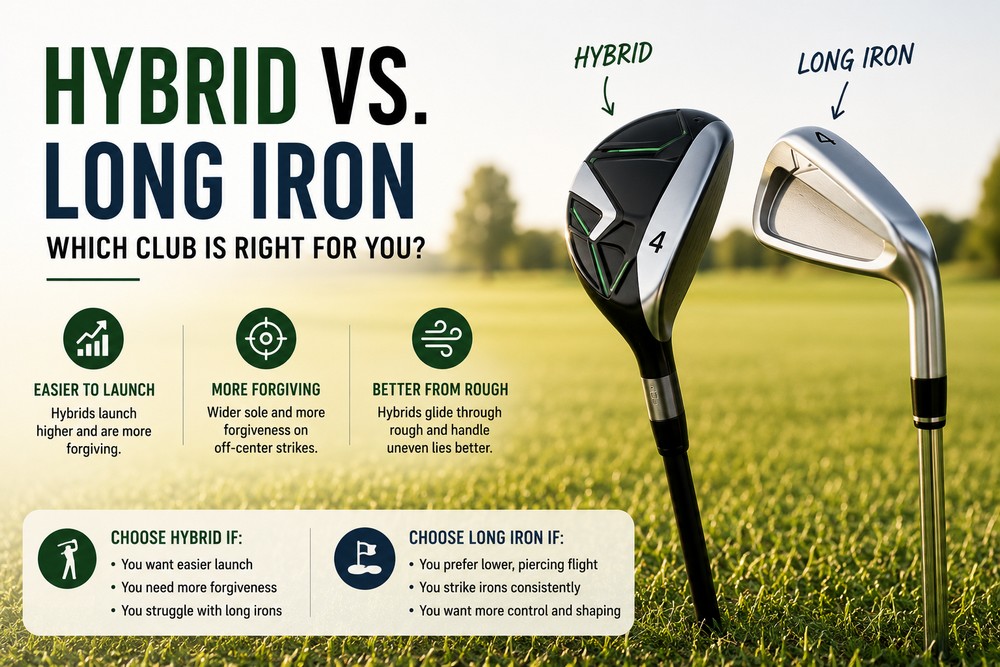
Hybrids were created to make long approach shots easier, but that does not mean every golfer should replace every long iron.
For most beginners, higher-handicap players and moderate-swing-speed golfers, a hybrid is easier to launch and more forgiving than a traditional 3-, 4- or 5-iron. Stronger iron players may still prefer the lower flight, compact shape and control of a long iron.
The best choice depends on strike consistency, launch, preferred ball flight and how the club fits into the distance gaps in your bag.
Are Hybrids Easier to Hit Than Irons?
Hybrids are usually easier to hit than low-lofted long irons, especially 3-, 4- and 5-irons.
Their larger heads and deeper centres of gravity help launch the ball higher. The wider sole can also reduce the tendency to dig into the turf, while the more stable clubhead preserves more performance on slight mishits.
However, hybrids are not necessarily easier than every iron in the bag. Most golfers will still find a 7-, 8- or 9-iron easier to control for shorter approach shots.
The comparison therefore mainly concerns:
- Hybrids versus 2-irons
- Hybrids versus 3-irons
- Hybrids versus 4-irons
- Hybrids versus 5-irons for players who struggle with launch
Hybrid vs Long Iron Comparison
| Factor | Hybrid | Long iron |
|---|---|---|
| Launch | Usually higher and easier | Usually lower and more demanding |
| Forgiveness | More stable on slight mishits | More dependent on centre-face contact |
| Carry distance | Often longer at the same stated number | More dependent on speed and strike quality |
| Stopping power | Higher flight can create a steeper landing angle | Lower flight may release farther after landing |
| Rough performance | Often easier from light or moderate rough | Can be difficult from thicker lies |
| Wind | Higher flight may be affected more | Lower flight can suit windy conditions |
| Shot shaping | Often designed for straighter, easier launch | Can offer more iron-like trajectory control |
| Appearance | Larger, wood-like head | Compact iron profile |
| Best for | Most beginners and inconsistent long-iron players | Confident iron strikers with enough speed |
What Is a Hybrid Golf Club?
A hybrid combines characteristics of an iron and a fairway wood.
It normally has:
- A larger head than an iron
- A wider sole
- A deeper centre of gravity
- A shorter shaft than most fairway woods
- A more compact shape than a fairway wood
This construction is designed to make long shots easier to launch while retaining more control than a longer-shafted fairway wood.
Hybrids are commonly used to replace:
- 2-irons
- 3-irons
- 4-irons
- 5-irons for golfers who struggle with launch
Higher-lofted hybrids can also replace 6-irons in beginner, senior or slower-swing-speed sets.
What Is a Long Iron?
Long irons traditionally include the 2-, 3- and 4-iron. In many modern sets, the 5-iron can also behave like a traditional long iron because stronger lofts reduce launch.
Long irons have:
- Less loft than mid irons
- Longer shafts
- Smaller clubheads than hybrids
- Less help launching the ball
- More demanding centre-face contact
Many modern iron sets now begin at the 5-iron because manufacturers expect golfers to use hybrids, utility irons or fairway woods above that point.
Why Are Hybrids Easier to Hit?
Several design features make hybrids more forgiving than traditional long irons.
Deeper centre of gravity
A hybrid can position more mass lower and farther behind the face. This helps launch the ball higher with less effort than a compact long iron.
Wider sole
The wider sole can move through the turf without digging as sharply as a narrow long-iron sole.
This can help golfers whose contact is slightly heavy, although it does not completely correct a poor strike.
Larger, more stable clubhead
A hybrid head usually provides more stability when the ball is struck slightly away from the centre.
This can preserve more ball speed and reduce the penalty from moderate mishits.
Higher launch and landing angle
The easier launch can produce more carry and a steeper landing angle. That may help long approach shots stop more quickly on the green.
Confidence at address
Some golfers simply feel more confident looking down at a larger hybrid head than a thin long iron.
Confidence does not replace technique, but it can encourage a more committed swing.
Are Hybrid Irons Easier to Hit?
The term “hybrid irons” can describe two different products:
- Individual hybrid clubs that replace long irons
- Complete iron sets with wide soles and hybrid-style heads
Both are designed to improve launch and forgiveness.
A hybrid-style iron set may be useful for:
- Beginners
- Higher-handicap golfers
- Golfers with slower swing speeds
- Players who struggle to launch normal irons
- Golfers who prioritise consistency over a compact appearance
However, these clubs may produce a higher flight and less traditional feel than compact irons.
Why Some Golfers Prefer Long Irons
Long irons remain useful for golfers who can strike them consistently.
A confident iron player may prefer them because they:
- Provide a familiar iron-style appearance
- Produce a lower, more penetrating flight
- Can be useful in strong wind
- Maintain consistent shaft feel through the iron set
- Allow controlled punch shots
- May provide more predictable rollout from the tee
- Can feel easier to shape for skilled players
The compact profile can also suit golfers who dislike the visual size or draw-biased appearance of some hybrids.
Is a Hybrid Easier to Hit Than a 4-Iron?
For most golfers, yes.
A 4-hybrid normally launches higher, offers more forgiveness and requires less precise centre contact than a traditional 4-iron.
It may be especially useful for golfers who:
- Hit their 4-iron only slightly farther than their 5-iron
- Produce low shots that do not stay in the air
- Frequently strike the 4-iron thin
- Need more stopping power on long approaches
- Struggle from light rough
A strong player may still prefer the 4-iron for its lower trajectory and iron-style control.
Is a 5-Hybrid Easier to Hit Than a 5-Iron?
A 5-hybrid is usually easier to launch than a 5-iron, particularly for moderate or slower swing speeds.
It can also provide more carry on mishits. However, a 5-hybrid may travel farther than the matching 5-iron because it can have a longer shaft, hotter face and different launch characteristics.
That means it may overlap with a 4-hybrid or leave a large gap to the 6-iron.
Do not assume that a 5-hybrid automatically replaces a 5-iron simply because the numbers match.
Should a Beginner Use Hybrids?
For most beginners, replacing the lowest-lofted irons with hybrids is practical.
A beginner set may contain:
- A 4-hybrid
- A 5-hybrid
- A 6-iron or 7-iron as the first conventional iron
The correct transition point depends on which iron the golfer can still launch and strike consistently.
A golfer who hits the 6-iron well but struggles with the 5-iron may need only one hybrid. Another golfer may benefit from replacing the 4-, 5- and 6-irons.
The aim is not to carry as many hybrids as possible. It is to remove clubs that do not produce useful, repeatable distances.
Who Should Keep Long Irons?
Long irons may remain suitable when you:
- Generate enough clubhead speed to launch them properly
- Strike the centre of the face consistently
- Prefer a lower ball flight
- Play frequently in windy conditions
- Use long irons confidently from the tee
- Prefer a compact appearance at address
- Can create clear distance gaps through the set
A golfer should not replace a reliable long iron merely because hybrids are generally considered easier.
Which Iron Should a Hybrid Replace?
Do not match clubs only by the number printed on the sole.
A 4-hybrid does not always travel the same distance as a 4-iron. Hybrids often have longer shafts and can launch faster and higher.
Instead, compare:
- Loft
- Actual carry distance
- Total distance
- Launch height
- Landing angle
- Consistency
The hybrid should fill a useful distance gap rather than duplicate another club.
Hybrid Loft Guide
The table below provides approximate starting points only. Loft and club numbering vary significantly between manufacturers.
| Hybrid loft | Possible iron replacement | Possible overlap |
|---|---|---|
| 16–18° | 2-iron or strong 3-iron | 4-wood or 5-wood |
| 19–21° | 3-iron or strong 4-iron | 5-wood or 7-wood |
| 22–24° | 4-iron or 5-iron | Higher-lofted hybrid |
| 25–27° | 5-iron or 6-iron | Strong-lofted mid iron |
| 28–31° | 6-iron or 7-iron | Game-improvement mid iron |
Some modern irons use very strong lofts. A 5-iron from one set may have similar loft to a 4-iron from another, so published specifications should always be checked.
Can You Carry Both a Hybrid and a Long Iron?
Yes. Many golfers use a mixed setup.
Examples include:
- 3-hybrid and 4-iron
- 4-hybrid and 5-iron
- 2-utility iron and 4-hybrid
- 7-wood, 4-hybrid and 5-iron
Each club can serve a different purpose.
A hybrid may be used for higher shots from the fairway or rough, while a long iron or utility iron may provide a lower option from the tee.
The important factors are useful yardage gaps and distinct shot functions.
Hybrid vs Utility Iron
A utility iron sits between a traditional long iron and a hybrid.
It usually has:
- A hollow or partially hollow head
- More forgiveness than a traditional long iron
- A more compact profile than a hybrid
- A lower flight than most hybrids
A utility iron may suit a confident ball striker who wants additional forgiveness without switching to a wood-shaped hybrid.
A hybrid remains the easier option for most golfers who struggle with launch.
Hybrid vs Fairway Wood
Hybrids and fairway woods can cover similar loft and distance ranges, but they do not behave identically.
A hybrid normally has:
- A shorter shaft
- A more compact head
- Greater iron-like control
- More versatility from uneven lies
A fairway wood normally has:
- A longer shaft
- A larger head
- Potentially more distance
- A higher launch in many comparable lofts
Golfers should compare actual performance because a 19-degree hybrid, 5-wood and 7-wood may overlap substantially.
Can You Hit a Hybrid From the Rough?
Yes, hybrids are often useful from light and moderate rough.
The wider sole and rounded shape can help the club move through imperfect lies more effectively than a narrow long iron.
However, hybrids are not automatic rescue clubs. In thick or wet rough, the grass can close the face, reduce speed or make clean contact difficult.
From a poor lie, the safer decision may be to use a shorter club and return the ball to the fairway.
Can You Hit a Hybrid From the Tee?
Yes. A hybrid can be a useful tee club on:
- Short par fours
- Tight holes
- Long par threes
- Holes where accuracy matters more than maximum distance
Use a very low tee height so the ball sits only slightly above the ground. The swing should resemble a normal hybrid or iron swing rather than an upward driver swing.
Why Do Some Golfers Hook Hybrids?
Some hybrids are designed with draw bias or additional offset to help golfers who leave the face open.
For a golfer with a strong draw or hook, that design may cause the ball to turn left too easily.
Other possible causes include:
- A shaft that is too soft
- An overly upright lie angle
- A closed face at address
- A swing path that is too far from inside
- A grip that is too strong
Players who hook hybrids should consider a more neutral head shape, stiffer shaft or adjustable model rather than assuming every hybrid will behave the same.
How to Know When to Replace a Long Iron
Consider replacing a long iron when:
- It carries almost the same distance as the next iron
- The ball launches too low
- Centre contact is inconsistent
- You rarely use it because you lack confidence
- It cannot hold a green from its intended distance
- You hit it well only from a perfect tee lie
A useful bag should contain clubs that produce repeatable differences in carry—not merely different numbers on the soles.
Use the Golf Club Fitter
The Golf Club Fitter can recommend hybrid starting points based on player level, carry distance and the main problem you want to solve.
Frequently Asked Questions
Is a hybrid easier to hit than a 4-iron?
For most golfers, yes. A hybrid usually launches higher and provides more forgiveness on slight off-centre strikes.
Are hybrids easier to hit than irons?
Hybrids are generally easier than low-lofted long irons, but not necessarily easier than short or mid irons. They are mainly intended to replace difficult 2-, 3-, 4- and sometimes 5-irons.
What is the easiest hybrid to hit?
The easiest option is usually a forgiving hybrid with sufficient loft, a stable head and a shaft suited to the golfer’s speed. A higher-lofted 4- or 5-hybrid is normally easier to launch than a strong 2-hybrid.
Does a 4-hybrid replace a 4-iron?
Often, but not always. A 4-hybrid may travel farther because of its shaft length, head design and launch characteristics. Compare actual carry distances.
Does a 5-hybrid replace a 5-iron?
It can, but a 5-hybrid may carry farther and launch higher than the corresponding iron. Check the gap to both the 4-hybrid and 6-iron.
Should beginners use hybrids?
Most beginners benefit from replacing the lowest-lofted irons they cannot launch or strike consistently.
Do professional golfers use hybrids?
Yes. Some professionals use hybrids depending on course setup, weather, preferred trajectory and bag composition. Hybrids are not exclusively beginner clubs.
Can I hit a hybrid from the rough?
Yes. Hybrids are often effective from light or moderate rough, although very thick lies can still make clean contact difficult.
Can I use a hybrid from the tee?
Yes. Hybrids can provide a controlled tee option on short, tight holes and long par threes.
Is a hybrid better than a fairway wood?
Not universally. Hybrids are usually shorter and easier to control, while fairway woods may provide more distance and launch.
Should I replace my 5-iron with a hybrid?
Consider it when the 5-iron launches too low, produces inconsistent contact or carries little farther than the 6-iron.
Can I carry both a hybrid and a long iron?
Yes. A mixed setup can provide different trajectories and shot options, provided the clubs do not duplicate the same carry distance.