

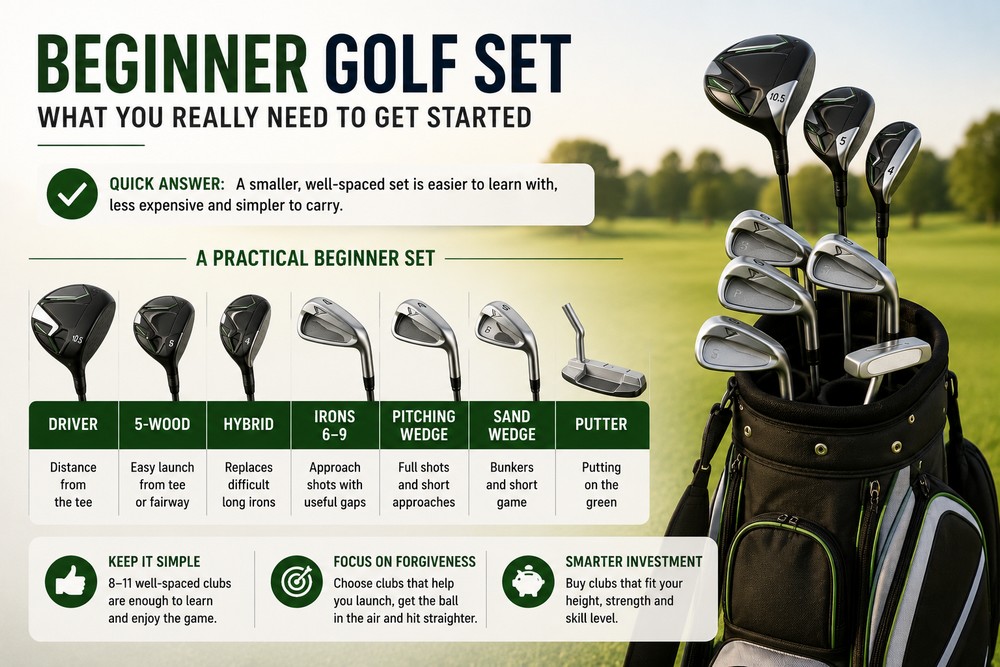
A beginner does not need fourteen clubs immediately. A smaller, well-spaced set can be easier to learn with, less expensive and simpler to carry.
How Many Golf Clubs Can You Carry?
The Rules of Golf allow a maximum of fourteen clubs during a stipulated round. That is a maximum, not a requirement.
Many beginners can learn effectively with eight to eleven clubs.
A Practical Beginner Golf Set
| Club | Why it is useful |
|---|---|
| Driver or high-lofted tee club | Distance from the tee |
| 5-wood or 7-wood | Easy launch from tee or fairway |
| 4- or 5-hybrid | Replaces difficult long irons |
| 6-iron to 9-iron | Approach shots with useful distance gaps |
| Pitching wedge | Short approaches and full wedge shots |
| Sand wedge | Bunkers and short-game shots |
| Putter | Putting on the green |
Should a Beginner Buy a Complete Set?
A complete package set can be excellent when the clubs are forgiving, the lengths are appropriate and the set composition makes sense.
Advantages:
- lower cost than buying every club separately
- matching bag and set
- simple buying decision
- usually designed for beginners
Disadvantages:
- limited shaft and length options
- some clubs may become less suitable as the golfer improves
- quality can vary between packages
Which Irons Are Best for Beginners?
Beginners usually benefit from game-improvement irons with:
- a larger clubhead
- a wider sole
- more perimeter weighting
- help with launch
- more stability on off-center strikes
Small blades and compact players irons are normally less forgiving.
Does a Beginner Need a Driver?
A driver is useful, but some beginners initially hit a fairway wood or hybrid more consistently. The goal is not to avoid the driver forever, but to have a reliable option while learning.
Which Wedges Does a Beginner Need?
A pitching wedge and sand wedge are enough for many beginners. Adding multiple specialty wedges too early can create overlapping distances and unnecessary complexity.
Should Beginners Use Graphite or Steel Shafts?
Graphite shafts are generally lighter and can help some golfers generate speed. Steel shafts are generally heavier and may provide a different feel.
The choice should be based on strength, speed, tempo and comfort rather than age or gender alone.
How Much Should a Beginner Spend?
Spend enough to get clubs that are the correct length, usable and in good condition. A suitable used set can be better than an unsuitable new set.
Prioritize:
- correct handedness
- reasonable club length
- forgiving head designs
- shaft weight and flex that are not excessively demanding
- useful distance gaps
- a comfortable putter
What Clubs Can a Beginner Skip?
Many beginners can skip:
- 2-, 3- and 4-irons
- multiple low-lofted fairway woods
- several specialty wedges
- compact blades
- low-lofted drivers designed for high-speed players
Use the Golf Club Fitter
The Golf Club Fitter can recommend complete sets, drivers, irons or hybrids based on your level, height, carry distance and main problem.
Frequently Asked Questions
How many clubs should a beginner carry?
Eight to eleven well-spaced clubs are enough for many beginners. The maximum allowed is fourteen.
Is a complete golf set good for beginners?
Yes, when the set is forgiving and reasonably suited to the golfer’s height and strength.
Does a beginner need a 3-iron?
Usually not. A hybrid or fairway wood is generally easier to launch and more forgiving.
Should beginners buy used golf clubs?
Used clubs can be a good choice when they are suitable, undamaged and correctly sized.
What driver loft is best for a beginner?
Many beginners benefit from more loft rather than less, but the correct loft depends on speed, strike and launch conditions.
Do beginners need custom-fitted clubs?
A full fitting can help, but a basic assessment of height, wrist-to-floor, shaft weight and set composition already prevents many poor purchases.