

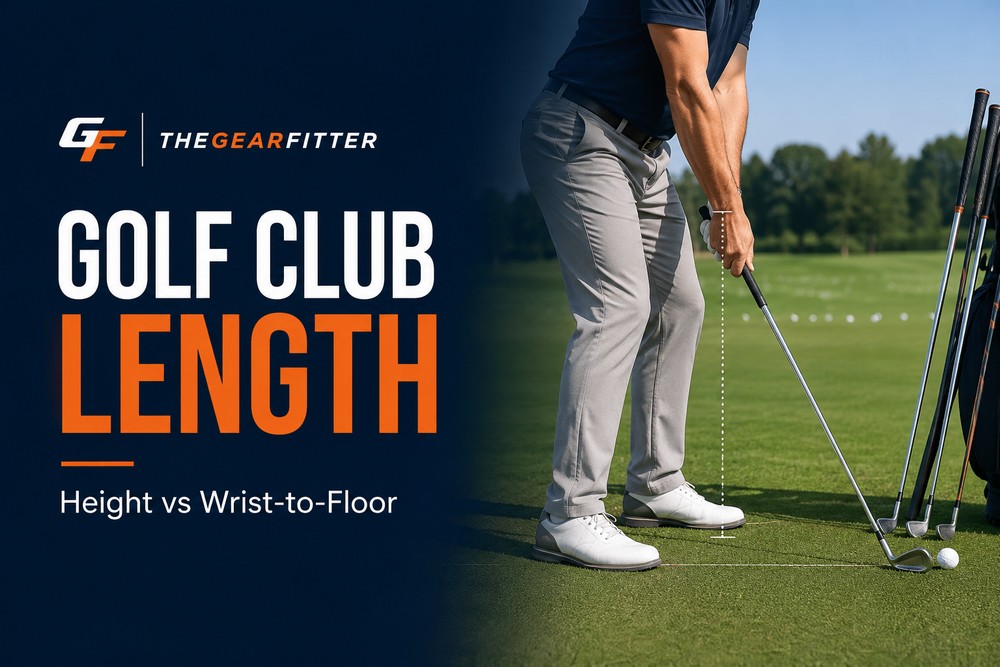
Height alone cannot determine the correct golf-club length. Two golfers can be exactly the same height but have different arm lengths, posture and address positions. One may fit standard-length irons, while the other may need shorter or longer clubs.
That is why club fitters commonly compare your height with your wrist-to-floor measurement rather than relying on height alone.
Golf Club Length by Height and Wrist-to-Floor Measurement
Use the chart below as a practical starting point for iron length. Find the height closest to yours, then compare your wrist-to-floor measurement with the ranges shown.
| Height | 1 inch shorter | 0.5 inch shorter | Standard | 0.5 inch longer | 1 inch longer |
|---|---|---|---|---|---|
| 160 cm 5 ft 3 in | 71 cm / 28 in or less | 72–73 cm 28.5–29 in | 74–80 cm 29–31.5 in | 81–82 cm 32–32.5 in | 83 cm / 32.5 in or more |
| 170 cm 5 ft 7 in | 76 cm / 30 in or less | 77–78 cm 30.5–31 in | 79–85 cm 31–33.5 in | 86–87 cm 34–34.5 in | 88 cm / 34.5 in or more |
| 180 cm 5 ft 11 in | 80 cm / 31.5 in or less | 81–82 cm 32–32.5 in | 83–89 cm 32.5–35 in | 90–91 cm 35.5–36 in | 92 cm / 36 in or more |
| 190 cm 6 ft 3 in | 85 cm / 33.5 in or less | 86–87 cm 34–34.5 in | 88–94 cm 34.5–37 in | 95–96 cm 37.5–38 in | 97 cm / 38 in or more |
| 200 cm 6 ft 7 in | 90 cm / 35.5 in or less | 91–92 cm 36–36.5 in | 93–99 cm 36.5–39 in | 100–101 cm 39.5–40 in | 102 cm / 40 in or more |
What Does a 36-Inch Wrist-to-Floor Measurement Mean?
A 36-inch wrist-to-floor measurement does not produce the same recommendation for every golfer. It must be compared with height.
For example:
- At around 5 ft 7 in / 170 cm: 36 inches is relatively high and may indicate that longer clubs should be tested.
- At around 5 ft 11 in / 180 cm: 36 inches falls near the transition between standard and approximately 0.5 inch longer.
- At around 6 ft 3 in / 190 cm: 36 inches can still fall within a standard-length starting range.
- At around 6 ft 7 in / 200 cm: 36 inches is relatively low and may indicate long arms and shorter clubs than height alone would suggest.
This is why searching for a recommendation based only on “36-inch wrist to floor” can be misleading. A golfer’s height is needed to interpret the measurement properly.
The Simple Principle
The relationship between your arms and overall height helps determine how far your hands naturally sit from the ground.
- Relatively long arms: Your wrists sit closer to the floor, so shorter clubs may provide a more natural address position.
- Relatively short arms: Your wrists sit farther from the floor, so longer clubs may be more appropriate.
- Average proportions: Standard-length clubs are usually a reasonable starting point.
The objective is not to force every golfer of a certain height into the same club length. It is to allow the golfer to address the ball in an athletic and repeatable posture.
How to Measure Wrist to Floor Correctly
A small measuring error can move you into a different range, so use a consistent method.
- Stand upright on a hard, level surface.
- Wear the type of shoes you normally wear when playing golf.
- Keep your feet naturally positioned and your weight balanced.
- Allow both arms to hang relaxed at your sides.
- Do not bend from the hips or reach your fingers towards the floor.
- Ask another person to measure from the main wrist crease to the floor.
- Measure both sides if you suspect a postural or anatomical difference.
- Record the result in both centimetres and inches.
Do not take the measurement while standing in your golf address position. Wrist-to-floor is normally a static body measurement taken while standing naturally.
Example Club-Length Recommendations
180 cm tall with an 86 cm wrist-to-floor measurement
A golfer around 180 cm tall with an 86 cm wrist-to-floor measurement falls within the standard-length starting range in this guide.
Standard irons should therefore be tested first.
180 cm tall with a 91 cm wrist-to-floor measurement
At the same height, a 91 cm measurement indicates that the hands sit farther from the ground. Testing irons approximately 0.5 inch longer would be reasonable.
180 cm tall with an 80 cm wrist-to-floor measurement
An 80 cm measurement is relatively low for this height and suggests longer arms. Irons approximately 1 inch shorter may provide a more natural starting position.
These recommendations should then be checked through posture, strike quality and lie-angle testing.
Why Height Alone Can Be Misleading
Height-based fitting charts assume that everyone has similar body proportions. In reality, leg length, torso length and arm length vary considerably.
A golfer who is 190 cm tall may not need longer clubs if they also have long arms. Their hands may already sit close to the ground.
A golfer who is 170 cm tall may still benefit from longer clubs if they have relatively short arms and their wrists sit unusually far from the floor.
This is why a height-only recommendation such as “all tall golfers need longer clubs” is unreliable.
Does Wrist-to-Floor Determine Exact Club Length?
No. Wrist-to-floor provides a static starting point, not a complete club fitting.
A final recommendation should also consider:
- Posture at address
- Ability to maintain balance
- Typical impact location on the clubface
- Swing plane and delivery
- Lie angle
- Clubhead design
- The manufacturer’s standard specifications
- Comfort and control
Two golfers with identical measurements may still receive different final specifications after hitting golf balls.
Club Length and Lie Angle
Club length and lie angle are closely related, but they are not the same fitting variable.
Lie angle describes the angle between the shaft and the sole of the club. It influences how the club sits at impact and can affect starting direction and turf interaction.
As a general tendency:
- Longer clubs: May require a more upright lie angle.
- Shorter clubs: May require a flatter lie angle.
However, length should not automatically determine lie angle. Your delivery at impact matters more than how the club appears while standing still.
A golfer may need longer clubs without needing a major upright adjustment. Another may use standard-length clubs with a significantly altered lie angle.
Signs Your Golf Clubs May Be Too Long
Clubs that are too long can make it harder to control the clubhead and maintain a natural address position.
Possible signs include:
- You feel forced to stand unusually upright.
- Your hands sit too far from your body.
- You frequently strike the ball towards the heel.
- The club feels difficult to control throughout the swing.
- Your centre-face contact is inconsistent.
- You grip down on every club to feel comfortable.
- Your posture changes noticeably with longer irons.
Heel strikes do not prove that a club is too long, but they can be one part of the diagnosis.
Signs Your Golf Clubs May Be Too Short
Clubs that are too short can force excessive bending and make the golfer feel cramped at address.
Possible signs include:
- You bend excessively from the hips.
- Your knees feel unusually flexed.
- Your arms feel crowded against your body.
- You frequently strike the ball towards the toe.
- You struggle to maintain posture through impact.
- The club feels uncomfortable even with a normal setup.
Toe strikes can also come from swing mechanics, so they should not be used as the only fitting criterion.
Should Beginners Use Standard-Length Golf Clubs?
Standard length is a sensible starting point for many beginners with average proportions, but it should not be treated as mandatory.
A beginner who is unusually tall, short, long-armed or short-armed may develop compensations when using an unsuitable club length.
Examples include:
- Standing too upright
- Bending excessively
- Moving farther from or closer to the ball
- Changing grip position to compensate
- Developing inconsistent strike patterns
Beginners do not necessarily need a complete tour-level fitting, but basic height and wrist-to-floor measurements can prevent an obviously unsuitable purchase.
Does This Chart Apply to Women’s Golf Clubs?
The body-measurement principle applies to every golfer, but “standard length” is not identical across all club ranges.
Women’s stock clubs are often built shorter and lighter than equivalent men’s models. Junior clubs use a separate progression based on the player’s size and development.
This means a recommendation such as “standard” or “0.5 inch longer” must be interpreted relative to the specific set you are buying.
Always check:
- The manufacturer’s published club length
- Whether the set is marketed as men’s, women’s or junior
- The reference club used for the length measurement
- Whether adjustments are measured from that manufacturer’s standard
Does Wrist-to-Floor Apply to Drivers?
Not in exactly the same way.
Height and wrist-to-floor measurements are most useful as a static starting point for irons and wedges. Driver length is influenced more heavily by centre-face contact, clubhead speed, dispersion and control.
A longer driver may create more potential clubhead speed, but it can also make centre contact more difficult. A shorter driver can sometimes produce better average distance because the golfer finds the centre of the face more consistently.
Driver fitting should therefore focus on:
- Impact location
- Ball speed
- Launch and spin
- Shot dispersion
- Confidence and control
Do not automatically apply an iron-length adjustment to the driver.
Does Wrist-to-Floor Apply to Putters?
Putter length depends more on putting posture, eye position, arm hang and stroke style than on the iron-fitting chart.
Wrist-to-floor can provide useful body-proportion information, but it should not be used alone to select putter length.
A suitable putter length should allow:
- A comfortable bend from the hips
- Relaxed arm position
- Consistent eye position
- Stable control of the putter head
Manufacturer Standards Are Not Identical
“Standard length” is not a universal measurement.
One manufacturer’s standard 7-iron may differ slightly from another manufacturer’s standard 7-iron. Clubhead design, measuring methods and product category can also affect published specifications.
Before ordering a custom adjustment, check the actual standard length of the model you intend to buy.
For example, “0.5 inch longer” means 0.5 inch longer than that manufacturer’s standard specification—not necessarily 0.5 inch longer than every other iron on the market.
Use the Golf Club Fitter
The Golf Club Fitter compares your height with your wrist-to-floor measurement and provides one of five practical starting points:
- 1 inch shorter
- 0.5 inch shorter
- Standard length
- 0.5 inch longer
- 1 inch longer
It also explains why the result was selected.
Frequently Asked Questions
What does a 36-inch wrist-to-floor measurement mean?
It depends on your height. At approximately 180 cm or 5 ft 11 in, 36 inches is near the transition from standard to slightly longer clubs. For a shorter golfer, it may indicate longer clubs, while for a much taller golfer it may still indicate standard or shorter-than-expected clubs.
How do I know if I need longer golf clubs?
If your wrist-to-floor measurement is relatively high for your height, your arms may be shorter in proportion to your body. Longer clubs may then provide a more comfortable starting position.
How do I know if I need shorter golf clubs?
If your wrist-to-floor measurement is relatively low for your height, you may have longer arms. Shorter clubs may allow a more natural posture and improved control.
Is wrist-to-floor more important than height?
Neither measurement should be used alone. The useful information comes from comparing wrist-to-floor distance with overall height.
Can tall golfers use standard-length clubs?
Yes. A tall golfer with proportionally long arms may fit standard-length clubs or only need a small adjustment.
Can short golfers need longer clubs?
Yes. A shorter golfer with proportionally short arms may need clubs that are longer than a height-only chart would suggest.
Should I measure with shoes on?
Yes. Wear normal golf or athletic shoes and stand on a hard, level surface.
Where should wrist-to-floor be measured from?
Measure from the wrist crease where the hand meets the forearm straight down to the floor while standing naturally with relaxed arms.
Does changing club length affect swing weight?
Yes. Length changes can alter the club’s swing weight and overall feel. A club builder may need to adjust head weight, shaft weight or grip specifications to maintain the desired balance.
Is this an exact custom fitting?
No. It is a static starting point. A dynamic fitting can confirm club length, lie angle, shaft choice, impact location and ball-flight performance.