

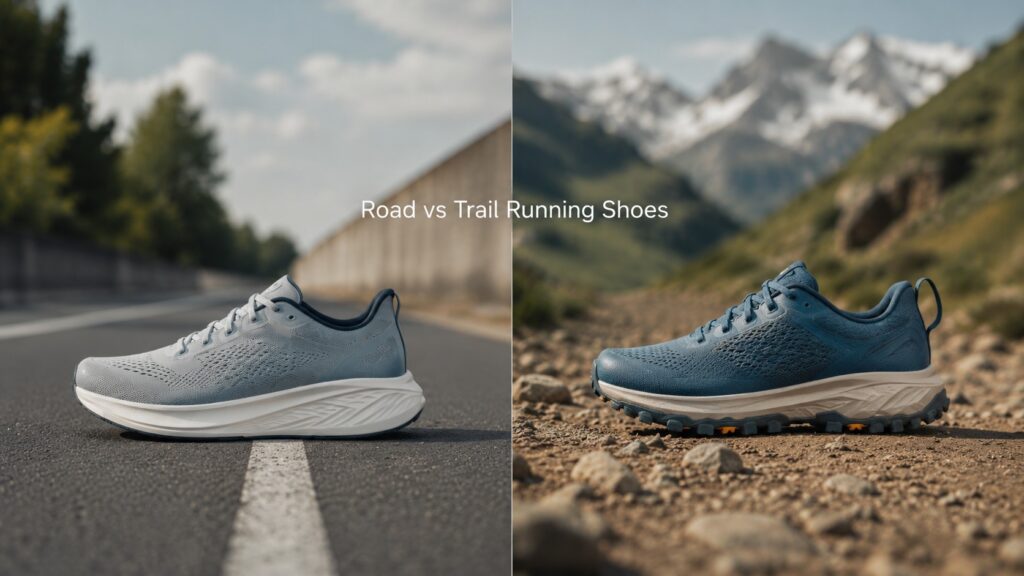
Road running shoes and trail running shoes may look similar, but they are designed for different surfaces and different types of movement.
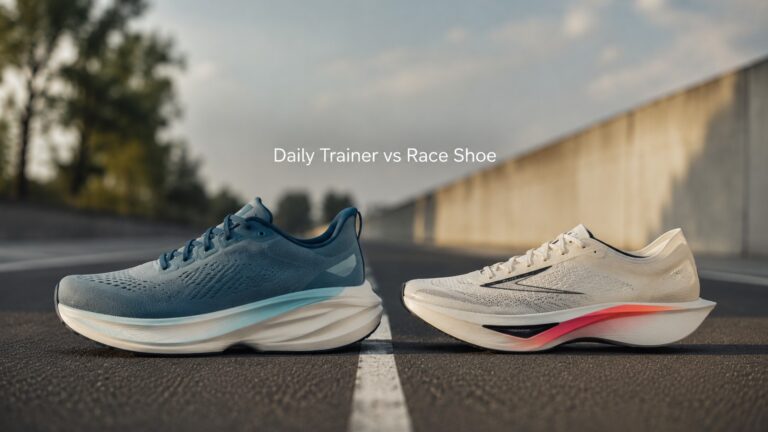
Road shoes prioritise smooth transitions, low weight and cushioning on predictable hard ground. Trail shoes add grip, protection and stability for loose, wet or uneven terrain.
The difference is therefore not limited to the outsole. The upper, midsole, platform, protection and overall fit can all change.
Road Running Shoes vs Trail Running Shoes
| Feature | Road running shoes | Trail running shoes |
|---|---|---|
| Best surface | Asphalt, pavement and smooth paths | Dirt, mud, gravel, rocks and uneven trails |
| Outsole | Flatter and smoother | Deeper or more widely spaced lugs |
| Weight | Usually lighter | Often heavier because of added protection |
| Protection | Minimal to moderate | Toe guards, reinforced uppers and sometimes rock plates |
| Stability | Designed for predictable surfaces | Designed for uneven and changing terrain |
| Cushioning | Optimised for repeated impact on hard ground | Balanced with grip, ground control and protection |
| Upper | Often lighter and more breathable | Usually stronger and more resistant to debris |
What Are Road Running Shoes?
Road running shoes are designed for firm, predictable surfaces such as asphalt, pavement, running tracks, treadmills and smooth park paths.
They usually use relatively flat outsole patterns because deep lugs are unnecessary on dry pavement. Their cushioning systems are designed to absorb repeated impact while allowing the foot to move smoothly from landing to toe-off.
Road shoes also tend to use lighter and more breathable uppers because they do not require the same level of protection against stones, roots and trail debris.
Road running shoes are best for:
- Asphalt
- Pavement
- Treadmill running
- Running tracks
- Smooth park paths
- Daily training on hard, predictable surfaces
- Road races
A normal road shoe can also handle occasional stretches of compact dirt or fine gravel, provided the surface is dry, level and not slippery.
What Are Trail Running Shoes?
Trail running shoes are designed for uneven, loose or unpredictable terrain.
Their outsoles normally use raised lugs that dig into dirt, mud, gravel or soft ground. Trail shoes may also include reinforced toe areas, stronger sidewalls and rock plates to protect the foot from stones, roots and other hazards.
The upper usually holds the foot more securely because lateral movement is greater when running across slopes, around rocks or over uneven ground.
Trail running shoes are best for:
- Dirt paths
- Forest trails
- Loose gravel
- Mud
- Wet grass
- Rocks and roots
- Mountain paths
- Steep or uneven terrain
Not every trail shoe is equally aggressive. Some are intended for smooth, dry paths, while others are designed for mud, mountains or highly technical terrain.
The Main Difference: Outsole Grip
The most visible difference between road and trail shoes is the outsole.
Road shoes normally use flatter rubber patterns that provide efficient contact with asphalt. They are designed to roll smoothly across a firm surface without the interruption of large lugs.
Trail shoes use raised sections of rubber called lugs. These create additional grip by biting into loose or soft ground.
The depth and shape of the lugs should match the terrain:
- Shallow, closely spaced lugs: Better for dry hard-packed trails, gravel and mixed road-to-trail use.
- Medium lugs: Useful for general forest trails and mixed conditions.
- Deep, widely spaced lugs: Better for soft mud and loose terrain because they can penetrate the surface and release mud more easily.
Deep lugs can feel awkward or unstable on hard pavement because less rubber remains in continuous contact with the ground. By contrast, a smooth road outsole may provide insufficient traction on wet mud, loose soil or slippery roots.
Protection and Upper Strength
Trail shoes usually provide more protection than road shoes.
Common trail-specific features include:
- Reinforced toe caps
- Stronger sidewalls
- More durable upper materials
- Rock plates under the forefoot
- Gusseted tongues that reduce debris entry
- Additional overlays for midfoot support
A rock plate is a protective layer placed between the outsole and the foot. It helps reduce discomfort when landing on sharp stones or roots.
Not every trail shoe includes a rock plate. Softer and less technical trail shoes may rely on foam thickness and outsole protection instead.
Road shoes normally use lighter, more flexible and more breathable uppers. This can improve comfort on warm road runs, but provides less protection from trail debris.
Cushioning Difference
Road-shoe cushioning is designed primarily for repeated impact on hard, even surfaces.
A road shoe can use a soft and highly cushioned platform because the landing surface is relatively predictable. The runner does not usually need to account for rocks, roots or steep side slopes.
Trail-shoe cushioning must balance comfort with control. A very soft or tall platform may feel comfortable on smooth trails, but it can become unstable when the foot lands at an angle on technical terrain.
Trail shoes therefore vary considerably:
- Low and firm trail shoes: Greater ground feel and control on technical terrain.
- Moderately cushioned trail shoes: A balance of comfort and stability for daily trail running.
- High-stack trail shoes: More protection and comfort over long distances, but potentially less precise on uneven ground.
The right amount of cushioning depends on the trail, distance, runner and personal preference.
Stability and Foot Lockdown
Trail shoes need secure lockdown because the foot moves in more directions off road.
On pavement, the foot mostly travels forward across a flat surface. On trails, it may move laterally while crossing slopes, avoiding rocks or changing direction.
A trail shoe should therefore hold the heel and midfoot securely without crushing the forefoot.
Important trail-fit features include:
- A secure heel counter
- Strong midfoot lockdown
- Enough toe space for descents
- No sideways movement inside the shoe
- A stable platform under the foot
A shoe can have excellent outsole grip but still feel unsafe when the upper does not hold the foot securely.
Can You Use Road Running Shoes on Trails?
Road shoes can be used on easy trails when the surface is dry, smooth and predictable.
Examples include:
- Well-maintained park paths
- Compact forest roads
- Dry canal paths
- Fine gravel
- Short, flat dirt sections within a road run
A road shoe becomes less suitable when the terrain includes:
- Mud
- Wet grass
- Loose stones
- Steep climbs or descents
- Wet roots
- Sharp rocks
- Uneven side slopes
The main limitations are grip, protection and lateral stability.
A road shoe with a broad platform and good rubber coverage may cope well with light trails. A narrow racing shoe with exposed foam and minimal outsole rubber is a much poorer choice.
Can You Use Trail Running Shoes on Pavement?
Yes, trail running shoes can be used on pavement, but whether this makes sense depends on the type of trail shoe and how much road running you plan to do.
A lightly lugged trail shoe can feel perfectly acceptable on short road sections. An aggressive mud shoe with deep, widely spaced lugs may feel heavy, firm and awkward.
Trail shoes are generally acceptable on pavement when:
- The road section is short.
- The lugs are shallow and closely spaced.
- The shoe has sufficient cushioning for hard surfaces.
- Your run combines pavement with gravel or easy trails.
- You are using a road-to-trail model.
Trail shoes are less suitable for pavement when:
- The lugs are deep and aggressive.
- The outsole feels hard and inflexible.
- The shoe is designed for mud or technical mountain terrain.
- Most of your weekly mileage is on asphalt.
- The shoe feels unstable as the lugs compress on hard ground.
Hard pavement can also wear down soft trail lugs faster than dirt. Once the lugs are worn, the shoe may lose the grip that made it useful on trails.
Trail shoes are not automatically dangerous on roads, but an aggressive trail model is usually an inefficient and expensive choice for regular pavement running.
What Is a Door-to-Trail Running Shoe?
A door-to-trail shoe is a hybrid model designed for runs that begin on pavement and continue onto gravel, forest paths or moderate trails.
These shoes normally combine:
- Road-style cushioning
- A relatively smooth ride on pavement
- Shallow or moderately deep lugs
- Additional outsole grip
- More protection than a normal road shoe
- Less weight and bulk than a technical trail shoe
They are best suited to runners whose routes include both hard surfaces and non-technical trails.
Examples of road-to-trail running shoes
| Shoe | Best use | General character |
|---|---|---|
| Hoka Challenger 7 | Road, gravel and smooth trails | Soft cushioning with a relatively road-friendly ride |
| Nike Pegasus Trail 5 | Mixed pavement and moderate trails | Responsive cushioning and versatile grip |
| Brooks Divide 5 | New trail runners and road-to-trail routes | Familiar road-shoe feel with extra protection and traction |
Hoka Challenger 7
The Hoka Challenger 7 is designed around the transition between road and trail.
Its cushioning and overall geometry are closer to a road-running shoe than an aggressive mountain shoe, while the outsole adds enough grip for gravel, forest paths and moderate trails.
Best for:
- Road-to-trail running
- Gravel paths
- Smooth forest trails
- Runners who prefer generous cushioning
Less suitable for: Deep mud, very loose terrain and highly technical mountain trails.
Nike Pegasus Trail 5
The Nike Pegasus Trail 5 combines responsive cushioning with an all-terrain outsole designed to move between road and trail.
It is appropriate for runners who want one shoe for pavement, compact dirt, gravel and moderate forest paths.
Best for:
- Mixed road and trail routes
- Daily running on varied surfaces
- Dry or moderately wet trails
- Runners who like the feel of a conventional road trainer
Less suitable for: Deep mud and highly technical terrain where more aggressive lugs and greater protection are required.
Brooks Divide 5
The Brooks Divide 5 is positioned as an accessible transition from road running to trail running.
It combines a road-shoe-style fit and cushioning with additional traction and protection, including a rock plate.
Best for:
- Runners beginning trail running
- Road-to-trail routes
- Gravel and moderate trails
- Those who want a familiar road-shoe feel
Less suitable for: Very muddy or highly technical trails where a more specialised outsole is needed.
Are Trail Shoes Better for Gravel?
It depends on the type of gravel.
A normal road shoe is often sufficient for:
- Fine, compact gravel
- Flat canal paths
- Dry park tracks
- Short gravel sections within a road run
A trail or road-to-trail shoe becomes more useful when the gravel is:
- Loose
- Deep
- Wet
- Uneven
- Combined with dirt, grass or rocks
For mixed gravel and pavement, shallow lugs are normally more practical than an aggressive trail outsole.
Are Trail Shoes Waterproof?
Trail shoes are not automatically waterproof.
Many use breathable mesh uppers that allow water to enter but also dry relatively quickly. Waterproof versions commonly use membranes such as Gore-Tex to reduce water penetration.
Waterproof trail shoes can be useful for:
- Cold rain
- Wet grass
- Shallow puddles
- Winter conditions
They may be less suitable in warm weather because waterproof membranes usually reduce breathability. Water can also enter over the collar during deep stream crossings and then drain more slowly.
Choose waterproofing according to the climate and route rather than assuming it is always better.
Can You Walk in Trail Running Shoes?
Yes. Trail running shoes can work well for walking, hiking and everyday use, particularly on uneven paths.
However, the same pavement limitations still apply. Aggressive lugs may feel awkward on hard floors and can wear faster when used extensively on asphalt.
For mixed walking on streets, parks and light trails, a door-to-trail shoe is usually more practical than a technical mud shoe.
Common Mistakes
Buying aggressive trail shoes for smooth park paths
A heavy mud shoe with deep lugs is unnecessary for dry, well-maintained paths. It may feel slower and less comfortable than a lighter trail or road-to-trail model.
Using road shoes on wet technical trails
This is where outsole grip becomes a safety issue. Smooth road soles can lose traction on mud, wet roots, grass and loose descents.
Assuming every trail shoe is suitable for every trail
A shoe designed for dry gravel is not automatically suitable for deep mud. Trail conditions should determine lug depth, protection and stability.
Ignoring width and lockdown
Trail shoes need secure lockdown because the foot moves laterally on uneven ground. A shoe that is too loose can allow the foot to slide, while a shoe that is too narrow can create pressure during long runs and descents.
Choosing maximum cushioning without considering stability
A tall, soft trail shoe may feel comfortable on smooth paths but unstable when landing on rocks or sloping ground.
Using trail shoes for all road mileage
Trail shoes can handle pavement, but using an aggressive model for regular road training may feel less efficient and wear down the lugs unnecessarily.
Which Type Should You Choose?
Choose a road running shoe when:
- Most of your running is on asphalt or pavement.
- Your routes are smooth and predictable.
- You want low weight and smooth transitions.
- You are training or racing primarily on roads.
Choose a trail running shoe when:
- You regularly run on dirt, mud, roots or rocks.
- You need stronger grip and foot protection.
- Your routes include steep or uneven ground.
- You need secure lockdown for lateral movement.
Choose a road-to-trail shoe when:
- Your run begins on pavement and continues onto trails.
- You regularly combine asphalt, gravel and forest paths.
- Your trails are moderate rather than highly technical.
- You want one versatile shoe instead of separate road and trail pairs.
Bottom Line
Road running shoes are the best option for asphalt, pavement, treadmills and other predictable hard surfaces.
Trail running shoes provide the additional traction, protection and stability required for dirt, mud, rocks, roots and uneven ground.
Road shoes can handle smooth, dry trails, while trail shoes can handle occasional pavement sections. The greater the amount of mixed-surface running, the more useful a dedicated road-to-trail model becomes.
The Hoka Challenger 7, Nike Pegasus Trail 5 and Brooks Divide 5 are practical examples for runners who regularly move between pavement, gravel and moderate trails.